4/28/2015

Summer Beginnings

While biting my nails, waiting for the manuscript of my latest book “Present!” to be sent back by my editor, I intensely keep busy with other pursuits that take second fiddle to my writing.

One of them is painting.

Since that Sunday of Resurrection, when faith brethren in church got together to celebrate Easter by painting, I have not stopped. With every free time (from part-time summer teaching and marathon reading), I grab my brushes—and paint.

The last time I dabbled in painting was in 2006. This time, nine years later, I have decided to tackle  summer colors and patterns. 

Butterflies are it.

I really want to be an artist when I grow up. (I am as inept in painting as I am in cooking.) Painting, like reading, holds so much rapture for me, the restful kind. What grace that feeling is—it’s like lying down in green pastures, beside the still waters. Indefinable peace for the restless soul. 

I initially began painting on that glorious Sunday some palm fronds, topped with a butterfly hovering over flowers. The painting is unfinished; it needs re-touching and re-doing. I have an idea of what it needs; I just don't know if my hands are capable of doing them.

After that, I started a few more. Again they are all unfinished, needing a splash there and a swoosh here. Or maybe some dabs and rubs. But I signed one or two so the blame does not fall on anyone but me.

Then one day last week, my friend G, an artist of the first order (also an art director par excellence) joins me and tries to put some sense into my madness.

Oooh, she knows exactly what a teeny section needs and her hands obey her imagination. She gives me great tips here and there, but somehow, my hands rampage toward the messy, danger zones.

I get excited just thinking about my next images—my mind is definite, but my hands are iffy. So, let me give you a sneak peek of my initial works.

I call the series "Summer Beginnings." I hope to finish at least one before summer is gone—or before I get back to the reason I breathe: writing.

"He makes me lie down in green pastures. He leads me beside still waters. He restores my soul. He leads me in paths of righteousness for his name's sake.” Psalm 23:2-3 (ESV)

4/24/2015

Hat’s Off

To protect myself from the moist air during my dawn walks, I wear a hat.  The hat stays till I reach home at 6 AM.

Today, seconds after the first glimmer of the morning sun, I took my hat off—approximately at step 4,000 (according to my pedometer), and about 5:34 AM.   
 
It is summer. 

Dewdrops pop and vanish as soon as the sun peeps and makes its way over the horizon.

When I ended my walk at step 7,500 (seven kilometers), the sun was shimmering all around. Dogs were barking, people were chattering, and birds were singing. Even Tony was up and smiling.

Before today, it would still be dark when I reached home at 6 AM. My path would be lit by street lamps and occasional school buses. Then I’d be welcomed by the aroma of egg omelet, fried rice, brewed coffee or some other yummy concoction from Ate Vi’s kitchen. The boys would still be in bed.  

Without my hat, my cropped hair gets blown by the wind and my head is infinitely lighter, like it were wafting freely with the tree leaves that fall from branches swaying to and fro along my route. The better to feel the whisperings of nature in my ear. Even my feeble eyes see clearly the bountiful grace in the neighborhood—it’s in all the flowers in bloom and the butterflies that kiss them.  

Tomorrow, the sun will come out even earlier and I’ll be hatless earlier, too. In a few weeks, I will definitely be hatless from my first step to my last.

Oh, I take my hat off to God. I take my hat off to His summer!

4/20/2015

Go Bananas

The one fruit that seems to reside permanently in our home is the banana. Tony buys a bunch almost daily (the yellow, seedless kind, which we call lacatan). And I am always surprised at how fast they disappear—and appear again. 
 
I can go through life without bananas, but obviously, the boys can’t. "I am living with three monkeys," I sometimes say, but nobody takes offense. At any given time, one of them—or all—are busy enjoying the yellow berry.

Without my knowledge, Ate Vi planted a banana tree in our garden. Yesterday, she asked me, “Want to see the beginning of banana fruits?”

Tada!


The first thing that came to my mind was to use it for my header. Not, “The boys will enjoy our very own bananas in a few weeks.” Those were Ate Vi’s words, said with her usual aplomb.

Our very own bananas. That’s what summer brings: a lot of sunshine that makes banana plants bear bunches of banana fruits.

Then she gives me another surprise. “Since you don’t go much for bananas, you will soon have your very own favorite atis, too.”

She leads me to the atis tree—and there, hanging from one of the branches is a solitary atis! “Oh, there will be more,” she said with her standard poise.


That made me, pardon the pun, go bananas.  

In just two surprising moments in our garden, much of summer grace has come—and from our very own trees.

The bananas go up:
 
The dew drop goes down:  

4/17/2015

Day of Resurrection

On the Sunday Christians all over the world celebrate the resurrection of Jesus, adults and children in my home church resurrect our love for the arts. 

After the Sunrise Service, our spiritual family breaks bread together, then those who nurse a closet (or overt) passion to paint go to work in our church yard.

This is a tradition we started four years ago. And it seems to be gaining ground.

This year, more kids join the session. Especially because the objective is to gather 40 paintings for exhibit on our church’s 40th anniversary in September. All amateurs, we are guided by our Youth Pastor who has done more artworks than all of us put together. 

“I didn’t go to art school,” he apologizes. “I just love painting.”  Those exact words would have come from my mouth, but the difference between him and me is that, judging from his body of wonderful works, he definitely has the talent! 

The last time I put my paint brushes to use was at the same time and place last year. Busyness in writing and some teaching relegated those brushes in a corner where they gathered dust for 365 days.

I’ve always said that although I love painting, painting doesn’t love me. What my mind sees is not what my hands deliver. My gifts lie elsewhere, but the wonderful feelings painting brings becloud the inability.

I am not complaining; I am thanking the resurrected Savior for giving us areas of interest that rain untold joy, untold grace.

 As soon as I get home, I show Tony (an art enthusiast) the photo of our harvest.

“This one’s excellent!" he singles out the work of Jillian, aged 9. "And this. And this. Confident strokes,” he adds. The works of the kids impress him! Sigh, he ignores mine.

That challenges me to slave over my painting some more, to come close to the kids’. I spend the rest of the day urging my hands to do what I want to see.

At day’s end, “Nah.” The hands simply can’t deliver, but the heart brims with gladness. And I lift up my brushes in praise of my resurrected Lord!  
 
“May my prayer be set before you like incense; may the lifting up of my hands be like the evening sacrifice.” Psalm 121:2

Photos:grabbed from the FB pages of Karen and Ching

4/13/2015

Grace Period

That much-appreciated limited period of time in which penalties are not imposed even if you are late—for whatever (insurance, class, appointment, or any kind of bill)—is called grace period. Very apt. Although undeserved, it is given out of consideration for inability.

Grace periods come with different time frames—some short, some long—but the important thing is: as long as you make it during this time, you are free from any obligation or punishment.

In sum, you or your payments are not considered late.

In the university where I teach, grace period is 15 minutes after the start of the official class hour. Beyond that, students are no longer accepted into the classroom.

Their penalty translates to missed opportunity (lecture, quiz, project, discussion, etc.) that leads to lowered grade.

A grace period is exactly that—it is grace; it is given to anyone who, even if late, has the same privileges as those who are on time.

On earth, our grace period within which to accept “the Way, the Truth, and the Life” is our lifespan. We are given our whole lifetime to say “aye” or "nay” to Jesus. 

Many people take their own sweet time, saying life has to be enjoyed first. The trouble is, tomorrow may not come; our life could end tonight or anytime. Beyond that, we will stand in judgment.

Alas, the grace period granted us cannot be taken for granted. 

“Yet you do not know what tomorrow will bring. What is your life? For you are a mist that appears for a little time and then vanishes.” James 4:14 (ESV)

Photo credit

4/09/2015

Foot in Mouth

Not only babies (and acrobats) can put their foot in their mouth.  
 
We can, too. I can and I do. 

Foot in mouth is an old idiom, originating from the foot-in-mouth disease (a deadly virus found in cattle), and dating back to the 1800s. The idiom refers to humans whose words get them in trouble.

It’s when you say something stupid, insulting, or hurtful that you regret. You wish you hadn’t said it, but it’s too late to take it back.

I am not exactly gaffe-prone—my mom taught me tact painstakingly—but once in a while, even if I mean well, my words land in the wrong direction.

This one’s an example, which I wrote about in my book Circle of Compassion. Even after so many years, remembering the incident still turns me red. 

ooo

I bumped into my old friend, Jim, in a busy hotel lobby. He was with a young boy about eight years old. “Hello, stranger!” he said, hugging me. “It's been, what, ten years? Meet my son Javis.”

“Hello, Javis! You look just as handsome as your dad. Where's your mom?” 

“I don't know where my mom is, OKAY?” he said angrily, running away and disappearing through the crowd. His worried father quickly ran after him.

Aw, did I put my foot in my mouth! Red with embarrassment, I immediately called up a mutual friend and told her what happened.

“It's still all very hush-hush,” she said. “After their spectacular wedding which awed you, me, and all other 1,000 guests, Jim and Nieves were not exactly the ideal couple we all thought they were. In the States, even with all the luxury in the world in a huge house, the marriage didn't work out. But they stayed together till their son turned seven last year. Nieves left their conjugal home and was never heard from since. Now Jim and their son Javis are back in the Philippines—for good.  And guess what . . .”   

“Thanks,” I said, unwilling to hear more.  


ooo
Foot in mouth is something we sometimes can’t avoid. But it is more than worth our while to think about words before we say them.

“Let no corrupting talk come out of your mouths, but only such as is good for building up, as fits the occasion, that it may give grace to those who hear.” Ephesians 4:29 (ESV) 

4/05/2015

Empty Promises

OPM. That was the acronym we used for clients and bosses who reneged on their promise because they either forgot about it or didn’t mean it at all. OPM is Oh Promise Me, a song in the 19th century. 

The world is indeed full of OPMs. Ads tell us we can be rich, fair, beautiful, tall, healthy, or even healed from a disease, if we purchased this or that product.

Politicians promise us a better life if we voted for them.

Friends say, “I’ll come and see you,” but never do.

“You’ll be okay, I promise you,” say some do-gooders when we are in bad shape; we’ll never be okay, not on the basis of their promise. 

“Promises are made to be broken,” is a saying we often quote.

Empty promises surround us all year, and maybe all through our lives.
 
Only God made a promise that is not empty. On Easter, according to preacher Steven Kellett, “God gave us emptiness that is full of promise.”

Easter has one, great promise proven by emptiness:

Empty cross—on that cross, Jesus offered His perfect life in our behalf; there, where His blood was spilled, He paid the penalty for our sins. Anyone who asks for forgiveness will be forgiven. 

“He was handed over to die because of our sins, and he was raised to life to make us right with God.” Romans 4:25 (NLT) 

Empty tomb—He did not remain in the tomb, just as any believer in Jesus who dies on earth will be risen from the grave to eternal life.

“He isn't here! He is risen from the dead, just as he said would happen. Come, see where his body was lying.” Matthew 28:6     

Indeed, God gave us emptiness so full of promise—the promise of eternal life witnessed by man on Easter: 

“Jesus replied, ‘Now the time has come for the Son of Man to enter into his glory. I tell you the truth, unless a kernel of wheat is planted in the soil and dies, it remains alone. But its death will produce many new kernels—a plentiful harvest of new lives. Those who love their life in this world will lose it. Those who care nothing for their life in this world will keep it for eternity.’” John 12:23-25  

Happy Easter everyone!

4/03/2015

Hope

Someone very close to my heart died from drug overdose at age 30.

I knew him since he was 16 years old. His parents, who spoke very little English and Filipino, would request me to go to Ian's (not his real name) school in their behalf to settle misbehavior issues with the Rector. On our third meeting within the same year, the Rector warned, “Ian would be kicked out if we caught him smoking marijuana again!” 

It didn't happen again, but Ian had progressed from grass to cough syrup to shabu to cocaine in the next few years while in college.

Again and again, I would talk to him. Again and again, he got jailed. Again and again, his parents would bail him out.

One day he was convinced to check into a very expensive rehab facility. But he escaped after a few days and his parents would check him into a new one . . . ad infinitum. I couldn't keep track of the number of rehab houses, the amount of money spent for his expensive addiction, and the slew of goods he stole in exchange for drugs as years went by.

When he was found lifeless, sprawled on the floor in his parents' home, his only sister ranted and raved, “My parents should have given up on him. Ian was born hopeless!”   

That stung me. At the cross two thousand years ago, God dispensed grace through Jesus: an open invitation for everyone to receive Hope.

But my dear Ian declined. 

As we reflect on Jesus’ suffering, death, and resurrection this Holy Week, may we accept the Hope offered to each one of us.

Nobody is ever born hopeless. Hopelessness is something we bring on to ourselves if we look the other way and decline our one and only Hope for life everlasting.

"But God showed his great love for us by sending Christ to die for us while we were still sinners.” Romans 5:8 (NLT)

(This post was adapted from my book “Circle of Compassion,” published by OMF Literature in 2012.)

3/31/2015

Family Bonding

We’ve gone where the world has gone! To that dark pit where gizmos have taken the place of face-to-face encounters:

Make no mistake about it, here we are all deep into great conversations, but not with each other. When have doodads taken over our lives?

This is the theme of my new book entitled Present! While writing it, I analyzed, bit by bit, the pitfalls of being attached to a digital thingy, based on a slew of research materials. But after sending the finished manuscript to my editor, I find myself falling into the trap and modeling it.

I’m afraid my credibility may have dripped down the sewer.

After the book shall have been edited, I will read it again—not as the writer but as a reader. I think I need that book more than anybody at this point.

Ancient Roman philosopher, Marcus Tullius Cicero, couldn’t have known about technology taking over our lives today when he said, “Silence is one of the great arts of conversation.” He never reckoned with this kind of family bonding. 

Going back to Present! I am now in the midst of the next publishing stage: waiting.

After hibernating the manuscript, waiting—the longest step in the long book-writing process—for the edited manuscript can take forever. I am biting my nails as I look forward to the step after waiting: printing.

Right now I need a drink; I thirst for the calming grace of patience.  

3/27/2015

In the Same Boat

This idiom was first used by the ancient Greeks, referring to the risks shared by all passengers in a small boat at sea. Through time, the meaning came to include all people in similar, unpleasant circumstances at sea, on land, or in the air.

Let me go back to its origin to distil the complicated concept of life storms.  

These are problems that assault us, making us feel as though we’re sinking, drowning, being beaten by the swirling waters and turbulent tides in the deep blue sea.

In such situations, we desperately call out to God for help.

When the problem continues to rip us apart, we ask, "Are you sleeping, Jesus?"

Jesus was indeed sleeping!  

In a boat with His disciples, Jesus was asleep, unmindful of the dangers that lurked around them.

"But soon a fierce storm came up. High waves were breaking into the boat, and it began to fill with water . . . The disciples woke him up, shouting, 'Teacher, don’t you care that we’re going to drown? 

“When Jesus woke up, he rebuked the wind and said to the waves, 'Silence! Be still!'  Suddenly the wind stopped, and there was a great calm.

“Then he asked them, 'Why are you afraid? Do you still have no faith?'”

If you were in the same boat, wouldn't you be afraid, too? The possibility of drowning and dying is terrifying. 

But ah, Jesus was in the same boat, too!  The same boat being battered by waves and wind.

How easily we forget that when we suffer through harrowing experiences, He is with us. He will not allow us to sink; He calms the waves and wind.

But in truth, the real storm is not what's outside of us, but what is within us—fear. It’s gnawing fear that makes the situation seem worse; it’s our inner turmoil that needs calming.   

Jesus asks, "Do you still have no faith?"

Jesus is in the same boat. And if He is, should we be fearful? Should we even worry?

May His grace continue to steady and strengthen our fledgling faith. 

(Quoted verses: Mark 4:37-40 NLT)

Photo credit: Painting by Ludolf Bakhuizen, 1695

3/23/2015

Kenosis

I've been blessed with two wise, thinking bosses, from whom I have learned a lot.  (I omit from this post the creative, unstructured ones who honed my right brain.) 

The first, ABAJA, often turned on the light for me when I was still in the corporate world. Much of how my left brain behaves today I credit to him.

The second, Leo, is also a switchman. He regularly clicks the “on” of my academic light bulb.

He opened my eyes to the word kenosis. “Emptying,” he said.
 
We were talking about problem students—those whose plates are full with too many issues, all big in their mind, and therefore have no space even for a small serving of classroom lessons.

“Only when one’s mind is emptied of issues can he listen again,” he said. Those were not Leo's exact words, but that was the lesson I chose to learn.

This flashed back to my first guru. Before he retired he said, “I don't want to be somebody anymore. I just want to be nobody.”  From his FB posts, I have no doubt that emptying has done him wonders. 

Christians believe that self-emptying is the ethic of Jesus. He waived all privileges in His place of glory so He could be with us, like us, on earth. This self-sacrifice was for the redemption and salvation of all humanity.

Apostle Paul in fact urged the Philippians to imitate Christ's self-emptying. He issued a call for humility and for Christians to imitate Christ. “. . . he gave up his divine privileges; took the humble position of a slave and was born as a human being. When he appeared in human form, he humbled himself in obedience to God and died a criminal’s death on a cross.” Philippians 2:7-8 (NLT)

Uncanny how two bosses from two different worlds speak of kenosis—one in a corporate arena; the other, in an academic hub.  

Is it at all possible for modern man to be Christ-like and empty himself of worldly trappings and desires?

Only by grace.

3/19/2015

The Book, the Play, the Joy

The book: 

Originally written in English, No Lipstick for Mother won first prize in the Palanca Awards 2005.  It was re-told in Filipino by my friend, Dr. Luis P. Gatmaitan, a Palanca hall-of-fame awardee and a well-loved children’s book author.  

Both book versions (illustrated by Kora Dandan-Albano) have since delighted hundreds, hopefully thousands by now, of young readers here and abroad.

I wrote it to empower women. It focuses on the outer beauty that the world acknowledges (symbolized by lipstick) versus the unfading inner beauty God wants women to cherish.

March being National Women’s Month in the Philippines, I thought it might be relevant to re-visit the book.    

The Play:

No Lipstick for Mother is now also a stage play! 

Not in English, not in Filipino, but in Cebuano.

It was produced in Cebu by Childlink Learning Center and Childlink High School Inc. Directed by no less than the school’s directress, Maria Theresa F. Tio, the play delighted young and old audiences alike.

I wish I had watched it. But Manila and Cebu are a flight apart. If only I had been able to conjure a magic carpet, I’d have turned myself into Aladdin. 

The Joy: 

Photos of the play arrived via email—images I would keep and treasure as priceless and precious possessions.

As soon as I saw them, I rose from my computer chair and gave the cast and crew a standing ovation.

Literature and drama are two different art forms. But what thrills me most about the book is that the story lent itself well to 3-D movements and songs, and that, aside from readers, it had been able to send the message to a live audience. 

Before March ends, may all my cyber friends be granted the grace of joy in celebrating National Women's Month.

"Don’t be concerned about the outward beauty of fancy hairstyles, expensive jewelry, or beautiful clothes. You should clothe yourselves instead with the beauty that comes from within, the unfading beauty of a gentle and quiet spirit, which is so precious to God.” 1 Peter 3:3-4 (NLT) 

3/15/2015

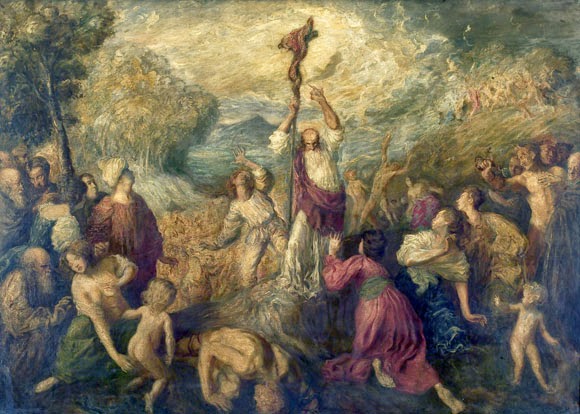
Serpent vs. Serpent

While reading my chronological Bible, I found a strange story that made me sit up, ponder and wonder. It’s found in Numbers 21:4-9.

The people of Israel complained again (for the umpteenth time) and God again (!) punished them.  Even after being severely punished over and over by God for past disobedience, they never learned their lesson.

This time, the Lord sent fiery serpents that bit people to their death.  

And as he did many times before, Moses begged the Lord to spare the people. God, in his infinite patience, again relented. He provided a very specific, odd remedy to save them.

God instructed Moses to make a fake fiery serpent made of bronze and set it on a pole. He said that anyone who looked at it will live.

Moses did just that.
 
Now, why would God use a serpent to save the people from the serpent? Why would He tell Moses to make an image of the very thing that was killing his people?

This must have been the same questions asked by some of the stubborn Israelites who simply refused to look—and died. 

But those who looked upon the bronze serpent with the eyes of faith lived, even as the serpent’s venom was already draining life from their bodies.

Many years later, however, the reigning king, Hezekiah, destroyed the bronze serpent after consultation with God. Why?

Over time, it morphed into an object of idolatrous worship—it had become a god. People burned incense before it and worshiped it, instead of God.  What was meant to be good was turned into evil.

That is the story of our lives.

In the beginning, Adam and Eve were given a paradise. But they believed a serpent more than God. Again and again, despite umpteenth chances, man keeps falling into evil ways.

That’s why over two thousand years ago, God gave sinful men the ultimate Grace on a cross: His only Son became sin so that through Him we will have a chance to be in paradise with God. 

Those who gaze upon that cross with the eyes of faith will be healed from the scourge of sin and live with Jesus forever.    

"God saved you by his grace when you believed. And you can't take credit for this; it is a gift from God.”  Ephesians 2:8 (NLT)

Photo: Moses and the Brazen Serpent, 1898, Augustus John (1878–1961), Oil on canvas

3/11/2015

Hibernating

Deposit it inside a drawer for hibernation . . . 
 
That's what I just did with the manuscript of my latest book.

This is the step in my writing that I take very seriously. This is also the time when I spend my time doing nothing except celebrating. Hence, as has been my ritual on this blogsite when I celebrate, my header changes:

From here . . .
To here . . .
Am I making sense?

Not at all, not to anyone.

This one's all about my personal writing process, which some people may find odd. 

After furiously writing for months—writing, re-writing, revising, re-revising, editing, re-editing, printing the draft, tearing it up, re-printing, editing again—I finally come to a version I am comfortable with. But before I send it to my editor, I send it to a drawer to hibernate for at least two weeks.

During such time, I forget about it.

After the silent two weeks, I read it again.

And I see them! Them are those errors or lapses that escaped me. How did I ever miss them? Duh. 

They glare at me saying, "Work, work, work some more!"

And I obey. I tweak and twist, push and pull all day, all night.  

Then off to my editor the manuscript goes, right on time for my deadline.

There are many more steps and more months before the manuscript becomes a book, if it all, but that's another saga I will blog about some other time.

Meanwhile, let me dwell in the grace of my manuscript's hibernation.

"With all my heart I will praise you, O Lord my God. I will give glory to your name forever . . ."  Psalm 86:12 (NLT)

By the way, in case you’re interested, my book's working title is "Present!"

3/07/2015

Big Best Breakfast

Have you been treated to a blast of blessings all at once?

I was. And I asked myself, What did I do to deserve this? 

Amidst months of busy, busy days, over the weekend Tony and I traveled to the place where I grew up, bringing along with us my best cuzzin Minna who was visiting from New York after a long while.   

The landscape has changed, like it always does when I make those rare trips home.  The new highway cut our traveling time down to half; instead of lean-tos, new Manila-like shops lined the streets. The dirt bends and the trees of my youth have aged beyond recognition. 

Yet, the fervor of family get-togethers remained the same. My siblings and their spouses, who likewise all went home for this impromptu cuzzin-welcome, met us with warm how-wonderful-to-see-you-again hugs, coupled with digital clicks.

We had grand activities like visiting a mountain resort and kunol-kunol (translation: chats with disjointed sentences and laughter on any topic that comes to mind), but none more magnificent than the big best breakfast that extended up to lunch before we said our good-byes. 

My brother Dave and his wife, Gladys, live in a manor with an herb garden for a backyard. There we spent the night and in the morning, we were surprised by an all-natural breakfast, with a platter of omelets courtesy of their duck farm—prepared with TLC by the two of them.

“Eat, eat,” I ordered our special guest, Minna, who, like me, was dazed by the array of food.

“My heart is full,” she said, digging in. 

Grace is like that. It feels your heart, my heart, even if I didn’t do anything to deserve it.

3/03/2015

How Intelligent Are You?

Intelligence is an extremely complex subject. 
 
There are IQ tests that measure intelligence, but debates are raging over their flaws.

In fact, Guinness retired the "Highest IQ" category in 1990 after concluding IQ tests are too unreliable to designate a single record holder.

But I am writing about two of those found with the highest IQs because I find them fascinating:  

One is a Korean named Kim Ung-yong, born in 1963, with an IQ of 210.

He started speaking at the age of six months and was able to read Japanese, Korean, German, English and many other languages by his third birthday.

At age four, he had memorized about 2000 words in both English and German. At age eight, he was invited by America’s NASA and conducted research work for 10 years. He also received a Ph.D in Physics at Colorado State University a few years later.

But at age 13, Kim was burnt out and returned to his homeland. He shocked everyone by choosing an ordinary office work. Apparently, people expected him to reach the moon. But he says, “I have found my bliss.”  

The other genius, James William Sidis, an American (1898-1944), was credited to have an IQ of 250-300. At age two, he could read English; at age four, he was typing original work in French. A year later, he had devised a formula to accurately name the day of the week for any given date. At eight, he projected a new logarithms table based on the number twelve.

James entered Harvard at age 12 and graduated cum laude.  By this time, he could speak and read fluently French, German, Russian, Greek, Latin, Armenian and Turkish.

At some point in his life, however, James said, “I am tired of thinking.” He took on obscure mechanical jobs that paid just enough for his subsistence.

The lives of these two geniuses show us that intelligence, like everything else we own on earth, does not bring on happiness or success. 

The road to eternal joy and pleasures is Jesus, the Grace birthed for us in a lowly manger thousands of years ago. Without Grace, all that we have on earth burns out. 

“You make known to me the path of life; you will fill me with joy in your presence, with eternal pleasures at your right hand.”  Psalm 16:11

Photo credit: smitsonianmag.com 

2/28/2015

God Doesn’t Make Sense

Even to hard-core believers, sometimes God doesn’t make sense.  

This, in essence, was what I gleaned from our pastor’s message one Sunday. I nodded so hard the pew shook and my head almost came off my neck.

Why would a God Who loves us, Who came down His throne to save inconsequential us from our sins, allow senseless things to happen?

Why would God allow 44 police (SAF) to be massacred by heartless murderers?

Why would God allow pastors and missionaries to be persecuted and killed?

Why wouldn’t God answer the prayers for peace in war-torn countries?

And the most shuddering news in recent days—the barbaric beheading of 21 Christians by the ISIS. Why would God allow His children’s innocent blood to spill into the sea?

From accounts of those who witnessed the savage execution, the helpless victims were repeating the words “Lord, Jesus Christ.” Some screamed “Yeshua!”

When Pope Francis visited the Philippines recently, a 12-year-old girl asked him through her tears, “Why is God allowing [bad things] to happen, even to innocent children?”

The head of over 1.2 billion Roman Catholics was stumped. Visibly moved, he had no answer. He could only say, “Only when we are able to cry are we able to come close to responding to your question.”

Humans have finite minds, and because we think simply, we can’t even begin to approximate God’s thoughts. In Isaiah 55:8, we read, "‘My thoughts are nothing like your thoughts,’ says the LORD. ‘And my ways are far beyond anything you could imagine.’”

No, we can never imagine the boundless grace that comes to us every second of every day. That’s why we don’t thank Him enough. Our simple minds simply can’t fathom the sense of many things happening to us.

We, hard-core believers in His unconditional love, with the faith of a child, can only trust, simply trust. 

2/24/2015

Computer with a Heart

Mothers might have invented the term “multitasking" long before it made its way to the dictionary.

From pregnancy to childbirth, until such time that our children can do things on their own, we hover around, busy with every task at home and at work (for working moms), dividing 24 hours and seven weeks into productive moments employers could only dream of.  

From my quick research, I discovered that the term “multitasking” was first used in a mechanical context in 1966 when technology began to dictate our way of life. It originated from the computer engineering industry, referring to the ability of a microprocessor to process several tasks simultaneously. 

Computer multitasking in single-core microprocessors involves time sharing. Only one task can actually be active at a time, but tasks are rotated every second.  Therefore, with the invention of multi-core computers, each core can perform a separate task simultaneously.

Sounds familiar? 

Yes, moms are like multi-core computers who can perform many tasks simultaneously. But, ah, there’s a big difference. A computer only has a “brain” created by humans.

It has no heart.

Moms have a heart—an extra-large one, if we go by sizes. We operate by and with that four-letter word called “love.”

How else can one work all day in the office and then come home to help her kids with their homework, put them to bed with a story, and sleep lightly at night so she could hear every unusual sound from the little ones? 

Then she wakes up at dawn to make sure that the kids have their “baon” and are ready for school. While in the office, she constantly calls home to check with the yaya (baby sitter) how things are going.

How about the food—groceries and meals? She plans those, too. And the house guests who hop in sometimes? How about when the kids get sick? Or have a special event in school? And her duties in her church and community? She juggles time between work, community, church, and school. 

Daunting chores!  

Then there’s her husband. And her home. They both need time—the husband, of course, gets the bigger share of caring.

My friend, Malou, has no house helper and her husband is an OFW. So she has to be both father and mother to their three kids.

Once I invited her to coffee and she told me about her jam-packed daily schedule. “Between my kids, their school, and our home, I am blessed to have this relaxing time.”  

After she narrated her typical day, I panted from exhaustion. “I got so tired just listening to your activities. You’re a super mom!” I said, meaning it. “How do you do it?”

“Through the art of multitasking,” she replied. 

“Art?! You have elevated multitasking to an art? But it’s the science of time management and multiple duties,” I replied, amazed.

She giggled. 

For moms, multitasking is a no-brainer. It has to do with the heart—a gift of grace from the Master Multitasker Who created the earth and everything in, over, around and under it.  

(Adapted from my column “Happy endings” in Moms and Kids Magazine) 

2/20/2015

Big Brother and Down Syndrome

February, the shortest month of the year, unpacked big events in succession: Valentine’s day; Chinese New Year; International Book Giving Day; and lest we forget . . .

February is National Down Syndrome Consciousness Month in the Philippines.

Many people are aware of Down Syndrome (DS) as a condition that afflicts one in 800 live births in the world. But not many know that children with DS, God's special blessings, possess great potential to live normal lives.

That’s why Republic Act 157 proclaimed February as National Down Syndrome Consciousness Month, under the auspices of the DSAPI:
 
It is to give Filipino children with DS "a mantle of protection against abuse, violence, and indifference." Like you, me, and every citizen, they deserve dignity and respect. 

These were the least we could do for my cousin Tinoy, born with DS.

He could speak only a few words and remained a child, but his parents never looked at him any differently. They were as proud of Tinoy as they were of their other children.

He was not kept at home, hidden from the world. This unconditional treatment rubbed off on everyone who ever met Tinoy—kith and kin alike.

In my visits with Tinoy when he and I were children, I taught him one word, ibon (bird), because he loved watching birds in flight. It took lots more visits and lots more practice before he could say, “uh-i-i-bon.”

What delighted me no end was, every time I’d see him (even a year or two apart), he would come to me and say, “uh-i-i-bon” and point to the sky.

These wonderful grace-encounters with Tinoy inspired the writing of “Big Brother” many years later, even if distance, time, and eventually his early death came between us.
 
“Big Brother,” a Palanca award winner and illustrated by Beth Parrocha-Doctolero, is a book of thanksgiving for the lives of Tinoy and every child born with DS.

It’s also a plea for those who’d chance upon the book to give kids with DS a chance to live full and decent lives.

I have always believed and felt, deep in my heart, that they could understand and feel more than we think they can—even if they remain as children while we grow up.

(Big Brother is available in all Philippine bookstores. It may also be ordered online through omflit.com)