Joy to the World is NOT a Christmas carol.
That got you, didn't it? It shocked me, too.
Among the many Christmas carols we sing this merry season, Joy to the World stands out as a favorite, or the most popular of them all.
In many places, in fact, this is sung with everyone being asked to rise, ending the event on a high, joyful note.
Growing up, I have always thought that it was composed as a Christmas song—to welcome the birth of Christ.
Recently, however, I found out that the English hymn writer who wrote it, Isaac Watts (1674-1748), based the song on Psalm 98 in the Bible. Let me quote here verses 7, 8, and 9:
Let the sea and everything in it shout his praise!
Let the earth and all living things join in.
Let the rivers clap their hands in glee!
Let the hills sing out their songs of joy before the Lord.
For the Lord is coming to judge the earth.
He will judge the world with justice.
Psalm 98 is about the second coming of Christ, not his birth. So the hymn Joy to the World is all about being joyful that Christ is coming back to earth to render justice to all people.
The song was first published in 1719 in Watts' collection—The Psalms of David.
Watts, a pastor, wrote many hymns and carols and was awarded a Doctor of Divinity degree by the University of Edinburgh in 1728. He penned the words of Joy to the World as a hymn praising Christ's triumphant return at the end of the age, rather than a Christmas song celebrating his first coming as a baby born to Joseph and Mary in a stable.
The music was adapted and arranged to Watts' lyrics by Lowell Mason in 1839 from an older, extremely popular melody, Handel's Messiah by George Frederick Handel (1685-1759), also often sung on Christmas.
After knowing all these facts, I looked up again the lyrics of Joy to the World. And true enough, they are about the joy we will feel when Jesus comes again!
For me, however, it does not really matter whether the song is for Christ coming to the world the first time or the second time. It is a triumphant song that expresses joy, fitting for the grandest birth of all.
So please join me as I sing the second and last stanza, and remember that over 2,000 years ago, a Baby was born in a lowly manger and all the world rejoiced.
Joy to the world, the Saviour reigns
Let Saints their songs employ
While fields and floods
Rocks, hills and plains
Repeat the sounding joy
Repeat, Repeat, the sounding joy
Rejoice! Rejoice in the Most High,
While Israel spreads abroad
Like stars that glitter in the sky,
And ever worship God,
And ever, and ever worship God.
By His grace, may the world have joy, joy, joy this Christmas!
12/14/2011
12/10/2011
My Author Story
How did I become an author? What or how much of me did it take to get there?
These were the questions I needed to answer in my talk at the Project Author Seminar of Salt and Light Ventures at the AIM conference hall.
Answering those two questions in book talks and casual encounters with readers has been no big deal. All I have time to say is an abridged version of how indeed did I end up being an author, when all my life I was an ad gal.
But to speak for 45 long minutes—now, that had to be a tell-all, including all the "lurid" details. This I only realized when I was beginning to write my talk.
These were the questions I needed to answer in my talk at the Project Author Seminar of Salt and Light Ventures at the AIM conference hall.
Answering those two questions in book talks and casual encounters with readers has been no big deal. All I have time to say is an abridged version of how indeed did I end up being an author, when all my life I was an ad gal.
But to speak for 45 long minutes—now, that had to be a tell-all, including all the "lurid" details. This I only realized when I was beginning to write my talk.
Alas, there was no turning back! I couldn't say no to the organizer's Chairman and CEO, my friend Ardy, who has been trying to arrange a meeting with me for a year now, but, well, you know how dates can be so ephemeral in this chaotic age, and so the appointment never happened.
I had to retrace my steps from the day I decided to have my manuscripts published. Then I discovered I had already been writing about those in bits and pieces in my book-in-progress on retirement, which I am currently fine-tuning before turning it over to my editor.
The book and the talk, they somehow dovetailed by coincidence, if not by divine providence.
As it happened, the talk was a preview of the book. And judging from the audience response, I ought to have at least a few guaranteed readers when the book goes to press. The feedback I got was totally and delightfully unexpected.
"I definitely will write my own story of grace NOW," someone said after my talk.
"Can't dilly-dally any longer. I need to take my manuscripts seriously soon," another one said.
"Now I know exactly what to write about—and I will go for it!" said a young gentleman.
"I've been mulling over these topics," a soft-spoken lady told me, showing me her notes. "Now I am confident I am in the right track."
I also got several private and wall messages on FB and email saying how my author story made them rev up their idling writing engine.
I had prayed that my talk would encourage the attendees to throw caution (and fear) to the wind and follow their heart: write.
That hope is now a certainty. If only 50% of the 40 who attended the seminar had been emboldened to have their thoughts published in print or on e-pages, then every second of the 45 minutes would have been worth it!
And oh, my author story is nothing spectacular compared to other authors'. My answer to both questions: it is a simple story of grace.
The book and the talk, they somehow dovetailed by coincidence, if not by divine providence.
As it happened, the talk was a preview of the book. And judging from the audience response, I ought to have at least a few guaranteed readers when the book goes to press. The feedback I got was totally and delightfully unexpected.
"I definitely will write my own story of grace NOW," someone said after my talk.
"Can't dilly-dally any longer. I need to take my manuscripts seriously soon," another one said.
"Now I know exactly what to write about—and I will go for it!" said a young gentleman.
"I've been mulling over these topics," a soft-spoken lady told me, showing me her notes. "Now I am confident I am in the right track."
I also got several private and wall messages on FB and email saying how my author story made them rev up their idling writing engine.
I had prayed that my talk would encourage the attendees to throw caution (and fear) to the wind and follow their heart: write.
That hope is now a certainty. If only 50% of the 40 who attended the seminar had been emboldened to have their thoughts published in print or on e-pages, then every second of the 45 minutes would have been worth it!
And oh, my author story is nothing spectacular compared to other authors'. My answer to both questions: it is a simple story of grace.
12/06/2011
Iloilo Hello (Part 2)
Blitzkrieg isn't a very wholesome term, but that's the word that pops out when I remember my Iloilo trip. It was like storming five places in rapid succession.
Book blitz it was, and I pray that the people whom I reached are a little better because of it. I am definitely better—more encouraged to reach and meet as many readers as I could. Bonding with them, feeling their palms, made me realize that a writer and readers are one.
In all three schools, I talked twice—first for the younger kids and second for the older ones. I actually asked for it. Initially, one school had all the children (pre-school to high school) assembled in one hall. I thought that talking to all would be like talking to none.
Division done, connection made—on to book signing. Kids make heart wrenching remarks and ask mind boggling questions.
Next stop: adults.
They were a totally different breed. Unlike children, they hold back and censor their thoughts, but just as warm. The seminar for singles drew a crowd of over 150, a few of whom are Compassion college scholars studying in Iloilo; it was great to see about a dozen of them there. The Q and A matched my whole talk in length.
Book blitz it was, and I pray that the people whom I reached are a little better because of it. I am definitely better—more encouraged to reach and meet as many readers as I could. Bonding with them, feeling their palms, made me realize that a writer and readers are one.
In all three schools, I talked twice—first for the younger kids and second for the older ones. I actually asked for it. Initially, one school had all the children (pre-school to high school) assembled in one hall. I thought that talking to all would be like talking to none.
Division done, connection made—on to book signing. Kids make heart wrenching remarks and ask mind boggling questions.
Next stop: adults.
They were a totally different breed. Unlike children, they hold back and censor their thoughts, but just as warm. The seminar for singles drew a crowd of over 150, a few of whom are Compassion college scholars studying in Iloilo; it was great to see about a dozen of them there. The Q and A matched my whole talk in length.
The teachers' seminar made me marvel anew at these noble professionals who love spending time—beyond what is required—with children. One of the attendees, a white-haired senior citizen, said she will never retire.
All book talks and seminars done on day three, I retreated to my room to pack. One last talk in a church the next day and then to the airport.
“Tired?” Angel 1, Lynnie, asked.
“Never,” I said, winking at Angel 2, Christine.
They both hied off to the mall and brought me home a packed dinner.
One hour later, my tummy was churning and burning, which I thought a good sleep would cure.
But at two in the morning, I woke up woozy, as though my stomach moved to my neck. I almost didn't make it to the bathroom. I wretched and wretched and wretched, and out came my dinner in spattering installments. After more wretching, debasing the pristine bathroom in the process, I felt like I ran around our village a hundred times, totally spent.
Me: Lord, are you telling me to rest?
God:
Me: Lord, is this my last day on earth?
God:
Me: Will you enable me to do my talk tomorrow?
God:
Cleaning up my mess, careful not to wake up Angel 1, Lynnie, took all the energy I had left. All zonked out, I barely crawled back to bed.
At seven AM, only half of me woke up. Towing my luggage, Angels 1, Angel 2, and I took a cab to church. I did my talk and signed books before the three of us rushed to the airport.
After strapping on my seat belt, I went out like a light, nudged only by my seatmate when it was time to deplane.
Home at last; some soup, then off to bed—all of 12 hours.
Waking up still weak to a new day, I was able to do the chores I had left behind. God had answered my questions the night before!
God: Yes, I am telling you to rest; blitzkrieg is over.
God: No, this is not your last day on earth; not yet.
God: Yes, I will enable you to talk in church; and you will.
Can grace ever be explained?
“Tired?” Angel 1, Lynnie, asked.
“Never,” I said, winking at Angel 2, Christine.
They both hied off to the mall and brought me home a packed dinner.
One hour later, my tummy was churning and burning, which I thought a good sleep would cure.
But at two in the morning, I woke up woozy, as though my stomach moved to my neck. I almost didn't make it to the bathroom. I wretched and wretched and wretched, and out came my dinner in spattering installments. After more wretching, debasing the pristine bathroom in the process, I felt like I ran around our village a hundred times, totally spent.
Me: Lord, are you telling me to rest?
God:
Me: Lord, is this my last day on earth?
God:
Me: Will you enable me to do my talk tomorrow?
God:
Cleaning up my mess, careful not to wake up Angel 1, Lynnie, took all the energy I had left. All zonked out, I barely crawled back to bed.
At seven AM, only half of me woke up. Towing my luggage, Angels 1, Angel 2, and I took a cab to church. I did my talk and signed books before the three of us rushed to the airport.
After strapping on my seat belt, I went out like a light, nudged only by my seatmate when it was time to deplane.
Home at last; some soup, then off to bed—all of 12 hours.
Waking up still weak to a new day, I was able to do the chores I had left behind. God had answered my questions the night before!
God: Yes, I am telling you to rest; blitzkrieg is over.
God: No, this is not your last day on earth; not yet.
God: Yes, I will enable you to talk in church; and you will.
Can grace ever be explained?
12/02/2011
Iloilo Hello (Part 1)
Iloilo is now a bustling metropolis, which was a pleasant surprise for me.
You know when a place has become totally modern and urban—traffic build-up isn't very far behind. I was there four years go and everything was five minutes away. This time around, we got caught in traffic while rushing to catch an early event.
Well, the traffic wasn't that bad really, not the kind we get in Manila on rush hour, but when you're on a marathon schedule, every tiny snag seems big.
The traffic build-up I am referring to is probably more about the bottleneck in my mind. I badly want to blog about all the exciting activities, but I came home to a work backlog that allows me only so much time and so much space.
My four-day Iloilo trip was much like all the trips I take to all parts of the country—book tour. But this one was jointly arranged by Philippine Christian Bookstore (PCBS) and OMF Lit. I was to visit three schools (two sessions in each, with different age groups) and speak in two seminars (one for teachers and one for singles).
Lots of talks, lots of book signing, lots of new friends, and lots of photos to show for them.

The children were as sweet as my favorite biscocho. And the teachers were as warm as the yummy kadyos (cooked with native chicken) I was treated to. Burp.


Two ladies and dear friends took care of everything for me: Lynnie of Cebu and Christine of Iloilo. If you look up the meaning of angel in the dictionary, you'll find their names in bold. PCBS and OMF Lit, thank you.
To say I had fun in Iloilo would be a lie. I had grace, grace, grace far beyond fun and one blog.
(Part 2 in a day or so)
You know when a place has become totally modern and urban—traffic build-up isn't very far behind. I was there four years go and everything was five minutes away. This time around, we got caught in traffic while rushing to catch an early event.
Well, the traffic wasn't that bad really, not the kind we get in Manila on rush hour, but when you're on a marathon schedule, every tiny snag seems big.
The traffic build-up I am referring to is probably more about the bottleneck in my mind. I badly want to blog about all the exciting activities, but I came home to a work backlog that allows me only so much time and so much space.
My four-day Iloilo trip was much like all the trips I take to all parts of the country—book tour. But this one was jointly arranged by Philippine Christian Bookstore (PCBS) and OMF Lit. I was to visit three schools (two sessions in each, with different age groups) and speak in two seminars (one for teachers and one for singles).
Lots of talks, lots of book signing, lots of new friends, and lots of photos to show for them.

The children were as sweet as my favorite biscocho. And the teachers were as warm as the yummy kadyos (cooked with native chicken) I was treated to. Burp.


Two ladies and dear friends took care of everything for me: Lynnie of Cebu and Christine of Iloilo. If you look up the meaning of angel in the dictionary, you'll find their names in bold. PCBS and OMF Lit, thank you.
To say I had fun in Iloilo would be a lie. I had grace, grace, grace far beyond fun and one blog.
(Part 2 in a day or so)
11/28/2011
Incomplete Rainbow
After seeing this photo, uploaded by a friend on Facebook, a thought hit me in my gut. This arc is not incomplete. It is I who do not see the whole splendor of it.
A rainbow is a perfect arc, with all the colors one can ever imagine. But sometimes we can't see all of it because clouds that crowd our lives block our vision.
I liken the arc to the truth, which we fail to see because we are short on faith. (I am trying hard not to sound like a theologian here because I am not; I can only speak, like I do in the books I write, from my heart.)
Faith is not a mental or emotional delusion, it comes to us through grace. In Romans 10:17 (NLT), we read: “So faith comes from hearing, that is, hearing the Good News about Christ.”
Just because I have great faith today doesn’t mean I have it the same way tomorrow, or forever after. Faith is something one has to pray for, work on, and work at having—by reflecting on God's Word every day of one's life.
A.W. Tozer said, “. . . it is not enough that we believe; we must believe the right thing about the right One.”
And what is the right thing about the right One?
It is spelled out in probably the best known verse in the Bible, “For God loved the world so much that He gave His one and only Son, so that everyone who believes in him will not perish but have eternal life.” John 3:16 (NLT)
Without the Savior's grace, nothing is. His promises hold in good and bad times. Believing in (being convinced and certain) and embracing this truth is faith.
The catch is, every day we experience disappointments and are saddled with all sorts of problems; we discover new, exciting ideas on the internet; we read new books that cite and paraphrase the Bible with beautiful reasoning that seems so right. Before long, we depart further and further away from the truth—and behold an incomplete rainbow.
How do we keep the faith? How do we get to see the complete arc?
Paul said that he "kept the faith." He did that by preaching the Word in season and out of season; his life was focused on the Gospel of Jesus to the very end.
We keep the faith when we are hearing the word of God and repeating it back to Him. Yes, as we talk about what Jesus has done for us, we keep faith.
Rom. 10: 9 (NLT), “If you confess with your mouth that Jesus is Lord and believe in your heart that God raised him from the dead, you will be saved.”
May the blessing of faith enable us to see the complete rainbow.
A rainbow is a perfect arc, with all the colors one can ever imagine. But sometimes we can't see all of it because clouds that crowd our lives block our vision.
I liken the arc to the truth, which we fail to see because we are short on faith. (I am trying hard not to sound like a theologian here because I am not; I can only speak, like I do in the books I write, from my heart.)
Faith is not a mental or emotional delusion, it comes to us through grace. In Romans 10:17 (NLT), we read: “So faith comes from hearing, that is, hearing the Good News about Christ.”
Just because I have great faith today doesn’t mean I have it the same way tomorrow, or forever after. Faith is something one has to pray for, work on, and work at having—by reflecting on God's Word every day of one's life.
A.W. Tozer said, “. . . it is not enough that we believe; we must believe the right thing about the right One.”
And what is the right thing about the right One?
It is spelled out in probably the best known verse in the Bible, “For God loved the world so much that He gave His one and only Son, so that everyone who believes in him will not perish but have eternal life.” John 3:16 (NLT)
Without the Savior's grace, nothing is. His promises hold in good and bad times. Believing in (being convinced and certain) and embracing this truth is faith.
The catch is, every day we experience disappointments and are saddled with all sorts of problems; we discover new, exciting ideas on the internet; we read new books that cite and paraphrase the Bible with beautiful reasoning that seems so right. Before long, we depart further and further away from the truth—and behold an incomplete rainbow.
How do we keep the faith? How do we get to see the complete arc?
Paul said that he "kept the faith." He did that by preaching the Word in season and out of season; his life was focused on the Gospel of Jesus to the very end.
We keep the faith when we are hearing the word of God and repeating it back to Him. Yes, as we talk about what Jesus has done for us, we keep faith.
Rom. 10: 9 (NLT), “If you confess with your mouth that Jesus is Lord and believe in your heart that God raised him from the dead, you will be saved.”
May the blessing of faith enable us to see the complete rainbow.
11/23/2011
Five Years and Counting
This site is turning five tomorrow, but I am blogging about it now because I need to catch some sleep for my early flight to Iloilo for book talks.
That's how long I have kept this blogsite.
In the beginning I thought I'd quit early in the game, but the thrill of writing one's thoughts on blogosphere, getting feedback from readers, and seeing the hit meter grow every hour kicked in. And now I want to keep slogging away.
I took on the theme "grace" because at that time I was writing my third "Gifts of Grace" book. I was reflecting on, analyzing, and studying grace with such ferocious focus that, really, it was not a choice. It was my only choice.
If there is one word I can never write enough about, it is grace. It is what keeps this e-leaf evergreen.
"How very quickly you see grace in everything," my friend Tere remarked after reading one of my posts.
"Anyone can see grace very quickly—all he needs is look," I replied.
"Huh?"
For five years, I swam in the excitement of numbers. Today, this is where I am:
- 112,050 hits from 154 countries;
- 500 reviews;
- 1530 comments;
- 506 posts;
- 12 change of headers (signifying milestones);
- and 98 followers.
How much more grace does one inconsequential blogger want?
This calls for a new header!
That's how long I have kept this blogsite.
In the beginning I thought I'd quit early in the game, but the thrill of writing one's thoughts on blogosphere, getting feedback from readers, and seeing the hit meter grow every hour kicked in. And now I want to keep slogging away.
I took on the theme "grace" because at that time I was writing my third "Gifts of Grace" book. I was reflecting on, analyzing, and studying grace with such ferocious focus that, really, it was not a choice. It was my only choice.
If there is one word I can never write enough about, it is grace. It is what keeps this e-leaf evergreen.
"How very quickly you see grace in everything," my friend Tere remarked after reading one of my posts.
"Anyone can see grace very quickly—all he needs is look," I replied.
"Huh?"
For five years, I swam in the excitement of numbers. Today, this is where I am:
- 112,050 hits from 154 countries;
- 500 reviews;
- 1530 comments;
- 506 posts;
- 12 change of headers (signifying milestones);
- and 98 followers.
How much more grace does one inconsequential blogger want?
This calls for a new header!
11/19/2011
Spell Sphygmomanometer
My computer can't spell the word. It has the jagged red line right under it!
Well, sphygmomanometer isn't a very popular word. If you're unfamiliar with it, then you either hate using seven-syllable words or too young to have high blood pressure.
This word is a contraption that measures one's blood pressure. I never paid much attention to it myself, not until I was recently told by my doctor to monitor my blood pressure. So between doctor visits, I had to keep looking for someone who had one. The search could take long—not too many people has even heard of the gizmo.
So JB brings an idiot-proof digital one for his dad and me on his last visit.
Opening the box, Tony and I alternately read the how-to-use leaflet. We are confident that with both our respectable IQs together, we should be able to make this never-before-seen modern gadget work.
The face of the sphygmo (nickname for this complicated word) has an initial reading of 135/85.
Connect the cable to the devise (check). Plug the same cable to the socket (check). Put the band around your arm (check). Push the “start” button (check).
The arm band inflates and deflates and then clicks off. Blood pressure? 135/85. A few more tries on me and then on Tony. Same reading: 135/85.
“This is a lemon!” Tony exclaims.
“JB should return it to the store!” I concur.
“He should get a replacement!” Tony adds.
“Or have his money refunded!” I say, reinforcing the issue.
When JB comes home that night, we whine about the faulty sphygmomanometer. “Both our blood pressure always came down to the same figures: 135/85!” we say in a duet.

JB unpacks the thingy, then patiently explains, making sure we both understand, “This here is a sticker, see? First, you have to peel it off.”

What?! 135/85 is a sticker?! A sticker?! A sticker?! I repeat in my mind. Tony's face tells me his mind is echoing mine.
Then our son, the doctor, who learned his ABCs from and shares his DNA with his parents, takes our blood pressure, then his.

I pay no attention to the results. I am more concerned over my new, more serious malady: Hypo-IQ.
When did it come about? How did it happen? Why were there no symptoms? Is there a cure? Is it terminal?
This digital age is driving analog people like us nuts. Oh, that we may be granted with an intensive dose of daily digi-grace!
Now, please excuse me while I go check my blood pressure.
Well, sphygmomanometer isn't a very popular word. If you're unfamiliar with it, then you either hate using seven-syllable words or too young to have high blood pressure.
This word is a contraption that measures one's blood pressure. I never paid much attention to it myself, not until I was recently told by my doctor to monitor my blood pressure. So between doctor visits, I had to keep looking for someone who had one. The search could take long—not too many people has even heard of the gizmo.
So JB brings an idiot-proof digital one for his dad and me on his last visit.
Opening the box, Tony and I alternately read the how-to-use leaflet. We are confident that with both our respectable IQs together, we should be able to make this never-before-seen modern gadget work.
The face of the sphygmo (nickname for this complicated word) has an initial reading of 135/85.
Connect the cable to the devise (check). Plug the same cable to the socket (check). Put the band around your arm (check). Push the “start” button (check).
The arm band inflates and deflates and then clicks off. Blood pressure? 135/85. A few more tries on me and then on Tony. Same reading: 135/85.
“This is a lemon!” Tony exclaims.
“JB should return it to the store!” I concur.
“He should get a replacement!” Tony adds.
“Or have his money refunded!” I say, reinforcing the issue.
When JB comes home that night, we whine about the faulty sphygmomanometer. “Both our blood pressure always came down to the same figures: 135/85!” we say in a duet.

JB unpacks the thingy, then patiently explains, making sure we both understand, “This here is a sticker, see? First, you have to peel it off.”

What?! 135/85 is a sticker?! A sticker?! A sticker?! I repeat in my mind. Tony's face tells me his mind is echoing mine.
Then our son, the doctor, who learned his ABCs from and shares his DNA with his parents, takes our blood pressure, then his.

I pay no attention to the results. I am more concerned over my new, more serious malady: Hypo-IQ.
When did it come about? How did it happen? Why were there no symptoms? Is there a cure? Is it terminal?
This digital age is driving analog people like us nuts. Oh, that we may be granted with an intensive dose of daily digi-grace!
Now, please excuse me while I go check my blood pressure.
11/15/2011
Discomfort Zone
“You were made for the discomfort zone. It engages you, keeps you sharp, and makes you grow,” thus said Curt Rosengren in his article in Motto Media.
He was of course referring to young, upwardly mobile career people, not to a Methuselah like me.
As a career person, I had no comfort zone. Advertising kept me on my toes and the new day was just as uncomfortable as the old one. “You are only as good as your last job,” was an adage that drove us. And a new job came even before the last one could end.
I finally found my comfort zone when I quit that job, which held me captive for years. Now, on my computer keyboard I could get lost for hours, skip meals and sleep. Comfort zone is a nice place to rest, get your footing, examine your heart, and bare your soul. I could stay there till kingdom come.
But came October—Missions month in church, to culminate in a group worship/celebration with eight other churches. The theme was local missions. Each church was tasked to perform something on its assigned ethnic group. Ours was Tausug and in the council meeting of elders, it was decided that the women's group would present a dance number: malong dance. (Malong is a tube skirt made of multi-colored cotton cloth similar to the sarong.)
Guess who had to be in it?
I had not danced in years. The last time was a Fox Trot number six years ago in a Rotary function. That was not too bad, I had danced Fox Trot in my youth and all it took was chutzpah to dance it again.
So on day one of the malong dance rehearsals, fellow Methuselahs whined every second on practically everything. There were five things to remember all at once: the steps, the counting, the music, the malong folding, and the hand movements. A good thing our dance instructor, April, was patience personified. She smiled through it all.
It took three rehearsals for the five-minute number. And when d-day came, I was reduced to a quivering mound of jelly—a panic attack not unlike those I went through in the ad world. “My heart went down to my toes,” I told our Pastor who laughed his hardest in years.
The long, loud applause told us it was excellent; the photos tell us a different story:
He was of course referring to young, upwardly mobile career people, not to a Methuselah like me.
As a career person, I had no comfort zone. Advertising kept me on my toes and the new day was just as uncomfortable as the old one. “You are only as good as your last job,” was an adage that drove us. And a new job came even before the last one could end.
I finally found my comfort zone when I quit that job, which held me captive for years. Now, on my computer keyboard I could get lost for hours, skip meals and sleep. Comfort zone is a nice place to rest, get your footing, examine your heart, and bare your soul. I could stay there till kingdom come.
But came October—Missions month in church, to culminate in a group worship/celebration with eight other churches. The theme was local missions. Each church was tasked to perform something on its assigned ethnic group. Ours was Tausug and in the council meeting of elders, it was decided that the women's group would present a dance number: malong dance. (Malong is a tube skirt made of multi-colored cotton cloth similar to the sarong.)
Guess who had to be in it?
I had not danced in years. The last time was a Fox Trot number six years ago in a Rotary function. That was not too bad, I had danced Fox Trot in my youth and all it took was chutzpah to dance it again.
So on day one of the malong dance rehearsals, fellow Methuselahs whined every second on practically everything. There were five things to remember all at once: the steps, the counting, the music, the malong folding, and the hand movements. A good thing our dance instructor, April, was patience personified. She smiled through it all.
It took three rehearsals for the five-minute number. And when d-day came, I was reduced to a quivering mound of jelly—a panic attack not unlike those I went through in the ad world. “My heart went down to my toes,” I told our Pastor who laughed his hardest in years.
The long, loud applause told us it was excellent; the photos tell us a different story:
11/11/2011
111,111
Since this is the 11th day of the 11th month of the year 2011, I am reminded of a friend's text message a month ago. She gave me many facts about this date, which I vaguely remember.
The only one I could recall is, if you add your age today to the year you were born, you get 2011.
But of course. Try doing that every year, and the sum is that same year.
She ended her message with, "Pass this on to 11 more people within 11 minutes and you will experience good fortune 11 times in the next 11 days."
Chain texts and chain letters leave me cold. They are the antithesis of my faith and what "Leaves of Grace" is all about. This I believe: all good things could only come from the Father of heavenly lights. Not from numbers, tarot cards, palms, luck, horoscope, colors, and many others that are credited for good fortune.
Everything that keeps us living a blessed life is grace.
What interested me about the message, however, was the number 11. Looking at my statistics today, this number jumped at me—111,111!
The only one I could recall is, if you add your age today to the year you were born, you get 2011.
But of course. Try doing that every year, and the sum is that same year.
She ended her message with, "Pass this on to 11 more people within 11 minutes and you will experience good fortune 11 times in the next 11 days."
Chain texts and chain letters leave me cold. They are the antithesis of my faith and what "Leaves of Grace" is all about. This I believe: all good things could only come from the Father of heavenly lights. Not from numbers, tarot cards, palms, luck, horoscope, colors, and many others that are credited for good fortune.
Everything that keeps us living a blessed life is grace.
What interested me about the message, however, was the number 11. Looking at my statistics today, this number jumped at me—111,111!
11/10/2011
Two Sets of Laughter
Dateline: HongKong
In a multi-racial conference, such as the Publishing Forum 2011 of Media Associates International (MAI), which I am attending, there are always two sets of laughter.
The first set comes from one part of the room immediately after a speaker has made a funny remark. The second set comes from the rest of the room only after the interpreter has translated what he said.
“The Tower of Babel is to be blamed for this,” I joke Aleks, seated beside me.
“The Tower of Babel is to be praised for this,” he jokes back, snickering. He, too, is as fascinated as I am with this double soundtrack, akin to delayed telecasts.
(A quick Bible background: At one time, all the people of the world spoke the same language, but when they began to build a great city with a tower that tried to reach the sky to make them famous, the Lord made the people speak different languages so they won't be able to understand each other and therefore can't do more than they were doing.)
Genesis 1:8-9 (NLT) says, “In that way, the Lord scattered them all over the world, and they stopped building the city. That is why the city was called Babel, because that is where the Lord confused the people with different languages.
Speaking in different tongues in one conference hall seems difficult for everyone to understand each other. But when you share the same faith and all believe in the saving grace of Jesus, there is understanding deeper than what our ears could hear. Our heart would feel what our mouths could barely say.
Breaking bread and praying with fellow believers for four consecutive days now, have been grace beyond comprehension. And hearing two sets of laughter each time, well, that's grace overwhelming.
Despite the sudden dip in temperature (freezing cold wind has assaulted us!), the warmth of fellowship remains.
In a multi-racial conference, such as the Publishing Forum 2011 of Media Associates International (MAI), which I am attending, there are always two sets of laughter.
The first set comes from one part of the room immediately after a speaker has made a funny remark. The second set comes from the rest of the room only after the interpreter has translated what he said.
“The Tower of Babel is to be blamed for this,” I joke Aleks, seated beside me.
“The Tower of Babel is to be praised for this,” he jokes back, snickering. He, too, is as fascinated as I am with this double soundtrack, akin to delayed telecasts.
(A quick Bible background: At one time, all the people of the world spoke the same language, but when they began to build a great city with a tower that tried to reach the sky to make them famous, the Lord made the people speak different languages so they won't be able to understand each other and therefore can't do more than they were doing.)
Genesis 1:8-9 (NLT) says, “In that way, the Lord scattered them all over the world, and they stopped building the city. That is why the city was called Babel, because that is where the Lord confused the people with different languages.
Speaking in different tongues in one conference hall seems difficult for everyone to understand each other. But when you share the same faith and all believe in the saving grace of Jesus, there is understanding deeper than what our ears could hear. Our heart would feel what our mouths could barely say.
Breaking bread and praying with fellow believers for four consecutive days now, have been grace beyond comprehension. And hearing two sets of laughter each time, well, that's grace overwhelming.
Despite the sudden dip in temperature (freezing cold wind has assaulted us!), the warmth of fellowship remains.
11/07/2011
Economics of the Poor
Am now in HongKong where I will facilitate a workshop for editors and writers in the Publishing Forum 2011 of Media Associates International (MAI), an organization that "helps local Christians create life-giving literature in the world’s hard places."
Participants are from Myanmar, China, HongKong, Thailand, Cambodia, Mongolia, Indonesia, Australia, Malaysia, India, UK, and the Philippines.


HongKong, as we all know, is a shopper's paradise. There are just too many whatchamacallits that seduce, “Take me.” Well, I am keeping my eyes off them.
When I was packing my bag two days ago, Tony was handing me two $100 bills. “You might need these."
The urge to grab the greenbacks came and went too briefly. “Thank you, but if I take those, I will be tempted to shop and spend them all.”
He readily put the tempters back in his wallet.
“Economics of the poor—in cash, not in spirit,” I told him. “You have nothing to spend, you don't spend.” For the first time in my life I budgeted only $100 as pocket money for a six-day stay in HK.
He argued no further.
In the old days, when I was in the corporate world, HK was a weekend destination on a whim with friends, or an all-expense-paid conference site for the company.
“Simplify,” has been my credo since I left that place where I was paid handsomely and given generous fringe benefits for traveling in style.
Today, I try to singly focus on writing and activities that support it. It's a no-frills job, which I love and enjoy, and I can't let old habits and excesses distract me.
By no means am I living a monastic life. I rather call it basic lifestyle. With basic needs daily given by grace, one should be at peace.
A Rolex and a Seiko, I discovered, tell the same accurate time. A bag bought from a designer boutique and a bag bought from a roadside booth, can carry the same things one needs while on the road.
Do I miss the frills of old?
No. What I miss is the thrill of accepting an extra $200 to spend as I please.
Could it be age?
My friend M, who is six years my senior, has a roomful of bling-bling, and the thrill of buying the next one is palpable a mile away. She once told me, “Items in HK are so cheap! After I had bought all I wanted, I still had $500 left!”
“You can entrust your $500 to me and I will give it to MAI.”
She slapped my arm and tittered, “Grace, you're so funny!”
Participants are from Myanmar, China, HongKong, Thailand, Cambodia, Mongolia, Indonesia, Australia, Malaysia, India, UK, and the Philippines.


HongKong, as we all know, is a shopper's paradise. There are just too many whatchamacallits that seduce, “Take me.” Well, I am keeping my eyes off them.
When I was packing my bag two days ago, Tony was handing me two $100 bills. “You might need these."
The urge to grab the greenbacks came and went too briefly. “Thank you, but if I take those, I will be tempted to shop and spend them all.”
He readily put the tempters back in his wallet.
“Economics of the poor—in cash, not in spirit,” I told him. “You have nothing to spend, you don't spend.” For the first time in my life I budgeted only $100 as pocket money for a six-day stay in HK.
He argued no further.
In the old days, when I was in the corporate world, HK was a weekend destination on a whim with friends, or an all-expense-paid conference site for the company.
“Simplify,” has been my credo since I left that place where I was paid handsomely and given generous fringe benefits for traveling in style.
Today, I try to singly focus on writing and activities that support it. It's a no-frills job, which I love and enjoy, and I can't let old habits and excesses distract me.
By no means am I living a monastic life. I rather call it basic lifestyle. With basic needs daily given by grace, one should be at peace.
A Rolex and a Seiko, I discovered, tell the same accurate time. A bag bought from a designer boutique and a bag bought from a roadside booth, can carry the same things one needs while on the road.
Do I miss the frills of old?
No. What I miss is the thrill of accepting an extra $200 to spend as I please.
Could it be age?
My friend M, who is six years my senior, has a roomful of bling-bling, and the thrill of buying the next one is palpable a mile away. She once told me, “Items in HK are so cheap! After I had bought all I wanted, I still had $500 left!”
“You can entrust your $500 to me and I will give it to MAI.”
She slapped my arm and tittered, “Grace, you're so funny!”
11/04/2011
Splurging on "Like"
If the “like” on FB had a price tag, I'd be spending a lot of money daily on the one page that keeps me riveted (“addicted,” my friend Boyp calls this new phenomenon) and sufficiently awed: “Come Visit My Philippines” (CVMP)
There are just too many breathtaking photos of our country that lure your fingers into clicking “like” practically every second.
What started "Come Visit My Philippines?"
An idea.
But an idea so big the page has grown in just a month to over 25,000 members, who have posted almost 7,000 stunning photos of and about the Philippines!
Mon Jimenez, our new Tourism Secretary, said upon accepting his new role, “Tourism is the people’s business . . . so if you believe that as I do, help me achieve that.” He likewise exhorted all Filipinos, “Believe in the beauty of your country. You deserve a visit from the world.”
Hearing Mon, friends Bessie Padilla and Alex Baguio (both photography buffs) started uploading their photos on their individual walls. They wanted to show the world that they “believe in the beauty of their country.”
The overwhelming response was unprecedented. Promptly, another friend, Francois Medina, joined the two to start an FB page for Filipinos who share their pride of country.
Thus, “Come Visit My Philippines” was born. The guidelines are simple: post a photo (anything Pinoy); briefly describe it; and punctuate it with the tagline, “Come Visit My Philippines.”
Because of the exponential growth of membership, more friends have been invited to help as administrators.
I have not posted one photo yet, because each time I prepare do so, I gawk at the mind-blowing masterpieces of others, and I spend an inordinate amount of time imagining the places where they were shot—taking all attention away from mine.
Here are a few which I randomly chose from thousands of spectacular photos on the page. These cut-and-paste collages are not as fascinating as the original ones, so please go to the FB-CVMP page and marvel at the individual photos as posted by the owners.
There are just too many breathtaking photos of our country that lure your fingers into clicking “like” practically every second.
What started "Come Visit My Philippines?"
An idea.
But an idea so big the page has grown in just a month to over 25,000 members, who have posted almost 7,000 stunning photos of and about the Philippines!
Mon Jimenez, our new Tourism Secretary, said upon accepting his new role, “Tourism is the people’s business . . . so if you believe that as I do, help me achieve that.” He likewise exhorted all Filipinos, “Believe in the beauty of your country. You deserve a visit from the world.”
Hearing Mon, friends Bessie Padilla and Alex Baguio (both photography buffs) started uploading their photos on their individual walls. They wanted to show the world that they “believe in the beauty of their country.”
The overwhelming response was unprecedented. Promptly, another friend, Francois Medina, joined the two to start an FB page for Filipinos who share their pride of country.
Thus, “Come Visit My Philippines” was born. The guidelines are simple: post a photo (anything Pinoy); briefly describe it; and punctuate it with the tagline, “Come Visit My Philippines.”
Because of the exponential growth of membership, more friends have been invited to help as administrators.
I have not posted one photo yet, because each time I prepare do so, I gawk at the mind-blowing masterpieces of others, and I spend an inordinate amount of time imagining the places where they were shot—taking all attention away from mine.
Here are a few which I randomly chose from thousands of spectacular photos on the page. These cut-and-paste collages are not as fascinating as the original ones, so please go to the FB-CVMP page and marvel at the individual photos as posted by the owners.
But oh, if you aren't a member yet, ask a friend who is. Adding your name will take only a second. I must warn you, though, you will be splurging on “like!”
P.S.
Let me thank my wandering friend, Boyp, who travels around the country as often as he blinks, for inviting me to enjoy the magnificent vista of grace bestowed upon the Philippines on CVMP!
P.S.
Let me thank my wandering friend, Boyp, who travels around the country as often as he blinks, for inviting me to enjoy the magnificent vista of grace bestowed upon the Philippines on CVMP!
11/01/2011
A Father Remembers
Today, as a tradition in our country, most Filipinos will trek to the cemetery to visit the graves of their loved ones. Many of them may already be there since the break of dawn.
I will not be one of them.
My reasons are neither the traffic nor the hassle to stay under the heat of the sun in a memorial park packed with the whole of humanity.
When my newly born son, Adriano, was buried by my husband, a couple of relatives, and a pastor-friend at the cemetery, while I stayed in my hospital bed nursing my grief, I knew that my little boy would never be lying in dirt six feet under the ground, he would always be in my heart.
I went to visit his grave a few times, albeit perfunctorily, with my husband and three other sons as a rite of remembering. But those were just a part of another lovely family outing.
I kept the attitude when years later, my dad then my mom were laid to rest in my hometown in a plot they bought years earlier. On November 1, every year, my siblings trek to that plot while I stay home in Manila pondering the grace I continue to receive through memories of them, in black and white.
The only way I know how to deal with death is write about it.
All of Tony's family also passed away one after the other (dad, mom, brother and sister) and again, I chose to swim in memories by writing about them—in my books, blog, journal, and diary.
There are many other loved ones—close aunts, uncles, friends, kith and kin—to whom I said good-bye as they were interred in their graves, but never visited again.
Tony is of a different mind. He has his own way of remembering.
Every year, sensing perhaps that I do not share his thoughts, goes alone to visit the tomb of our son—two days before November 1. I request him to take a shot of the tomb, for reasons I can't explain. He humors me. While there, he also takes photos of our close friends' tombs.

Not one of these photos ever shows a flower or a candle—traditional gifts to the departed. So in a way, he is different from others, too.
Once a year, on a different date, Tony also makes time to visit his family—all four of them—in one crypt in a Chinese Temple. He tells me he does paypay, a common Chinese practice of lighting a few sticks of incense and swaying them like a fan with both hands. He doesn't understand what it means, but he does it anyway.
People differ in how they view this day. While many feel the need to go to the cemetery, some stay home.
Two quotes come to me now as I imagine all the people in all cemeteries nationwide honoring their dead. One is the poem, “Do not stand at my grave and cry,” attributed to several authors. Here are the first two and last two lines:
Do not stand at my grave and weep
I am not there; I do not sleep.
Do not stand at my grave and cry,
I am not there; I did not die.
And the other was coincidentally quoted by my friend, Cherry, on her Facebook wall. It was what a mother, who lay dying, said to her son, St. Augustine: "Lay this body anywhere, let not the care for it trouble you at all. This only I ask, that you will remember me at the Lord’s altar, wherever you be.”
My thoughts of my own son today: I do not need to go to your graveside to remember, you're in my middle and there I visit you all the time.
But Tony, despite his busy schedule, travels the far distance to visit our Adrian's grave. Perhaps it's a father thing, a father's way of grieving—and healing.
I will not be one of them.
My reasons are neither the traffic nor the hassle to stay under the heat of the sun in a memorial park packed with the whole of humanity.
When my newly born son, Adriano, was buried by my husband, a couple of relatives, and a pastor-friend at the cemetery, while I stayed in my hospital bed nursing my grief, I knew that my little boy would never be lying in dirt six feet under the ground, he would always be in my heart.
I went to visit his grave a few times, albeit perfunctorily, with my husband and three other sons as a rite of remembering. But those were just a part of another lovely family outing.
I kept the attitude when years later, my dad then my mom were laid to rest in my hometown in a plot they bought years earlier. On November 1, every year, my siblings trek to that plot while I stay home in Manila pondering the grace I continue to receive through memories of them, in black and white.
The only way I know how to deal with death is write about it.
All of Tony's family also passed away one after the other (dad, mom, brother and sister) and again, I chose to swim in memories by writing about them—in my books, blog, journal, and diary.
There are many other loved ones—close aunts, uncles, friends, kith and kin—to whom I said good-bye as they were interred in their graves, but never visited again.
Tony is of a different mind. He has his own way of remembering.
Every year, sensing perhaps that I do not share his thoughts, goes alone to visit the tomb of our son—two days before November 1. I request him to take a shot of the tomb, for reasons I can't explain. He humors me. While there, he also takes photos of our close friends' tombs.

Not one of these photos ever shows a flower or a candle—traditional gifts to the departed. So in a way, he is different from others, too.
Once a year, on a different date, Tony also makes time to visit his family—all four of them—in one crypt in a Chinese Temple. He tells me he does paypay, a common Chinese practice of lighting a few sticks of incense and swaying them like a fan with both hands. He doesn't understand what it means, but he does it anyway.
People differ in how they view this day. While many feel the need to go to the cemetery, some stay home.
Two quotes come to me now as I imagine all the people in all cemeteries nationwide honoring their dead. One is the poem, “Do not stand at my grave and cry,” attributed to several authors. Here are the first two and last two lines:
Do not stand at my grave and weep
I am not there; I do not sleep.
Do not stand at my grave and cry,
I am not there; I did not die.
And the other was coincidentally quoted by my friend, Cherry, on her Facebook wall. It was what a mother, who lay dying, said to her son, St. Augustine: "Lay this body anywhere, let not the care for it trouble you at all. This only I ask, that you will remember me at the Lord’s altar, wherever you be.”
My thoughts of my own son today: I do not need to go to your graveside to remember, you're in my middle and there I visit you all the time.
But Tony, despite his busy schedule, travels the far distance to visit our Adrian's grave. Perhaps it's a father thing, a father's way of grieving—and healing.
![]() |
| (Photo by the graveyard maintenance man) |
10/29/2011
A Short Life Well Lived
Why would God allow a 15-year-old boy to die?
This was the question in our mind when Ronell, my grandnephew, died of Leukemia after only a month from diagnosis of the dreaded disease.
A whole family, a whole clan, a whole country, a whole world prayed, “Lord, please heal Ronell.”
The news of Ronell's sickness went viral after it was announced by an uncle on Facebook, Twitter, and e-mail. The message called for help—prayers, blood, and funds, in that order. And people from all walks of life rushed to the hospital, financial help poured, netizens from many countries twitted and sent messages of comfort and concern.
Despite the worldwide chorus of prayers, God chose not to heal Ronell. He took him instead.
Why???
At his wake, I hugged and asked Ronell's older brother, “Are you okay?”
“No, I am not okay,” he murmured.
It will take sometime before he and we will be okay. But his mom and dad put on a brave face as they thanked the hordes of people that packed the chapel, many of whom volunteered to speak during the necrological service:
“Ronell made me realize how important God is in our lives. He brought his Bible to school to tell me about the Savior.”
“I was never close to my parents, but from Ronell I learned the importance of family—and God.”
“He became a surrogate brother to my only son, who is so finicky about the people he goes with.”
“Always thoughtful, always gracious, always generous with his time in helping me and others.”
“He made me laugh, made me feel that everything was okay with the world because of God.”
“He never whined, not even when in pain.”
From the Pastor, who delivered the Memorial Service sermon, “Ronell, weak and drained in the hospital ICU, asked me if God really forgives sinners. When I said yes, his mouth twitched into a smile, despite his pain. That was a most beautiful moment.”
From an uncle, “I used to be reluctant in sharing God's word with friends. But after knowing what Ronell had been doing, young as he was, I am now emboldened to speak about salvation with anyone—even strangers.”
During his brief journey on earth, grace shone through Ronell and changed many lives—of friends, family, and strangers.
Someone said, “God spared Ronell from the landmines of evil forces on earth.”
It's all too clear—our heavenly Father plucked Ronell from his mortal coil to the peaceful place where He lives, because the boy we loved belongs there. Not tomorrow. Not next year. Not in the future.
Now.
This was the question in our mind when Ronell, my grandnephew, died of Leukemia after only a month from diagnosis of the dreaded disease.
A whole family, a whole clan, a whole country, a whole world prayed, “Lord, please heal Ronell.”
The news of Ronell's sickness went viral after it was announced by an uncle on Facebook, Twitter, and e-mail. The message called for help—prayers, blood, and funds, in that order. And people from all walks of life rushed to the hospital, financial help poured, netizens from many countries twitted and sent messages of comfort and concern.
Despite the worldwide chorus of prayers, God chose not to heal Ronell. He took him instead.
Why???
At his wake, I hugged and asked Ronell's older brother, “Are you okay?”
“No, I am not okay,” he murmured.
It will take sometime before he and we will be okay. But his mom and dad put on a brave face as they thanked the hordes of people that packed the chapel, many of whom volunteered to speak during the necrological service:
“Ronell made me realize how important God is in our lives. He brought his Bible to school to tell me about the Savior.”
“I was never close to my parents, but from Ronell I learned the importance of family—and God.”
“He became a surrogate brother to my only son, who is so finicky about the people he goes with.”
“Always thoughtful, always gracious, always generous with his time in helping me and others.”
“He made me laugh, made me feel that everything was okay with the world because of God.”
“He never whined, not even when in pain.”
From the Pastor, who delivered the Memorial Service sermon, “Ronell, weak and drained in the hospital ICU, asked me if God really forgives sinners. When I said yes, his mouth twitched into a smile, despite his pain. That was a most beautiful moment.”
From an uncle, “I used to be reluctant in sharing God's word with friends. But after knowing what Ronell had been doing, young as he was, I am now emboldened to speak about salvation with anyone—even strangers.”
During his brief journey on earth, grace shone through Ronell and changed many lives—of friends, family, and strangers.
Someone said, “God spared Ronell from the landmines of evil forces on earth.”
It's all too clear—our heavenly Father plucked Ronell from his mortal coil to the peaceful place where He lives, because the boy we loved belongs there. Not tomorrow. Not next year. Not in the future.
Now.
![]() |
| Second stanza of the gospel song, The Greatness of Our God (Hillsong) |
10/25/2011
Death of Latte . . . and Gadhafi
Our own rodent, Latte—one of JC's two guinea pigs—died about the same time Gadhafi did.
Brown like coffee with milk, and just as delightful, Latte suddenly refused her staple grass and after a couple of hours, she stopped breathing.
JC put her in a box and our househelper dug her grave, again—like all our other pets—beside all the flowers in our garden. Today we (I say, we, because although they're technically JC's, we love them just as much) only have one rodent, Earl Gray, who, we wish, will stay healthy.
I am drawn to the stark contrast of people's emotions between an insignificant rodent and an infamous strongman.
Gadhafi was a feared leader who died like a rat in a sewer. Latte was a precious rodent who died like a treasure in a home.
In a family of writing enthusiasts (husband, wife and sons), it isn't unusual to find pieces on God's grace written about something or other lying around. This time, JC wrote one about Latte. Sharing it with you . . .
You always were the brave one. Even before I bought you, there you were in that small cramped cage with your brothers, looking at me in the eye. Dehydrated and weak, your tiny feet sore from walking on that wire floor meant for birds, you reached out while I took a video of you.
You annoyed me to no end, blocking me every step of the way, every time I spot-cleaned your cage. Bigger isn’t always braver. You always swiped food from your much larger brother’s mouth every meal time. You never failed to push him aside each time he was at the water bottle.
You figuratively and literally stood tall for both of you, wheeking for food or attention. Truly, you were always more vocal, unafraid to speak your mind. EG has recently taken up the cudgels for you, but it’s just not the same.
Loud and brave, that was you. The one thing you were deathly afraid of was being picked up. You’ve always been skittish and uncooperative every time I tried to do that, but during your last week, you finally let me pet you without running away. Tough on the outside, there was a side of you that others hardly saw. You loved chin-rubs, and always looked like you were in a trance while I did that, thoroughly enjoying yourself.
It was a relatively busy and stressful week for me, and God gave you a little more strength to not show what you were really feeling, till the last moments, since that would have stressed me out. Even then, you bravely showed your trademark spunk, defiantly boxing the air and wheeking as you lay there.
Somehow, I knew you didn’t have long when I finally managed to carry you from your cage unaided, without so much a fight.
I thank the Lord for lending you for a little over a month. It reminded me that if a small, frail creature like you meant a lot to a sinful, finite being like me, how much more I, created in God’s own image, mean so much more to Him?
Goodbye Latte. We’ll miss you.
Brown like coffee with milk, and just as delightful, Latte suddenly refused her staple grass and after a couple of hours, she stopped breathing.
JC put her in a box and our househelper dug her grave, again—like all our other pets—beside all the flowers in our garden. Today we (I say, we, because although they're technically JC's, we love them just as much) only have one rodent, Earl Gray, who, we wish, will stay healthy.
I am drawn to the stark contrast of people's emotions between an insignificant rodent and an infamous strongman.
Gadhafi was a feared leader who died like a rat in a sewer. Latte was a precious rodent who died like a treasure in a home.
In a family of writing enthusiasts (husband, wife and sons), it isn't unusual to find pieces on God's grace written about something or other lying around. This time, JC wrote one about Latte. Sharing it with you . . .
You always were the brave one. Even before I bought you, there you were in that small cramped cage with your brothers, looking at me in the eye. Dehydrated and weak, your tiny feet sore from walking on that wire floor meant for birds, you reached out while I took a video of you.
You annoyed me to no end, blocking me every step of the way, every time I spot-cleaned your cage. Bigger isn’t always braver. You always swiped food from your much larger brother’s mouth every meal time. You never failed to push him aside each time he was at the water bottle.
You figuratively and literally stood tall for both of you, wheeking for food or attention. Truly, you were always more vocal, unafraid to speak your mind. EG has recently taken up the cudgels for you, but it’s just not the same.
Loud and brave, that was you. The one thing you were deathly afraid of was being picked up. You’ve always been skittish and uncooperative every time I tried to do that, but during your last week, you finally let me pet you without running away. Tough on the outside, there was a side of you that others hardly saw. You loved chin-rubs, and always looked like you were in a trance while I did that, thoroughly enjoying yourself.
It was a relatively busy and stressful week for me, and God gave you a little more strength to not show what you were really feeling, till the last moments, since that would have stressed me out. Even then, you bravely showed your trademark spunk, defiantly boxing the air and wheeking as you lay there.
Somehow, I knew you didn’t have long when I finally managed to carry you from your cage unaided, without so much a fight.
I thank the Lord for lending you for a little over a month. It reminded me that if a small, frail creature like you meant a lot to a sinful, finite being like me, how much more I, created in God’s own image, mean so much more to Him?
Goodbye Latte. We’ll miss you.
![]() |
| Latte (left) and Earl Gray |
10/22/2011
Gadhafi Did Not Die Like a Dog
"He died like a dog,” many newspapers wrote on how the former strongman—one of the most vilified leaders in recent history—died.
I say he didn't die like a dog; our dogs die better.

About half a dozen of our dogs over the years were buried deep in our garden under tall trees and beside flowering hedges. Our Vet put them to sleep, and we stayed silent as we awaited their last breath. Then we thanked God for their lives and for the joy they brought us.
This has been the ritual of dying for our—and I guess most pet lovers'—dogs. We do not parade them around town, bloodied, half naked, gasping for air, while we gloat and shout a slew of curses.
Gadhafi didn't die like a sewer rodent, either. Rodents die better. (JC wrote a beautiful piece on this, which I am tempted to include here—on second thought, it deserves a solo post next time.)
Did Gadhafi deserve the way he died? After all, he did the same thing, or worse, to many of his own people.
Well, did my 15-year-old grandnephew, Ronell, deserve the way he died? He suffered extreme pain, strapped to a dozen tubes, endured numerous blood transfusions, and was sapped with energy every day till the last fateful hour.
Did our loved ones—like my dad who fought an agonizing battle against cancer for four years—deserve the way they died?
Did those criminals, burned in electric chair, or those accused with treason, beheaded in public view, deserve the way they died?
Did those 19 young soldiers, killed by MILF in a fierce battle, deserve the way they died?
And to go on, did Marcos, who lived with debilitating Lupus for years, deserve the way he died? Or did Ninoy, whose life was snuffed out as soon as he set foot on his homeland, deserve they way he died?
Then the ultimate death that changed our world and all our lives, did Jesus deserve the way He died?
Except for the death of Jesus, which is so clear in the Scriptures why sinners killed Him in that manner, we can only speculate on ordinary mortals' way of dying.
Gadhafi's was just one in billions of earthly passing that had, has, and will come to every man.
We will not know the whys and the wherefores of death, but when we entrust our life to the sovereign God, believe in His power over every powerful dictator and powerless citizen the world over, He gives us grace to accept why death happens the way it does.
I say he didn't die like a dog; our dogs die better.

About half a dozen of our dogs over the years were buried deep in our garden under tall trees and beside flowering hedges. Our Vet put them to sleep, and we stayed silent as we awaited their last breath. Then we thanked God for their lives and for the joy they brought us.
This has been the ritual of dying for our—and I guess most pet lovers'—dogs. We do not parade them around town, bloodied, half naked, gasping for air, while we gloat and shout a slew of curses.
Gadhafi didn't die like a sewer rodent, either. Rodents die better. (JC wrote a beautiful piece on this, which I am tempted to include here—on second thought, it deserves a solo post next time.)
Did Gadhafi deserve the way he died? After all, he did the same thing, or worse, to many of his own people.
Well, did my 15-year-old grandnephew, Ronell, deserve the way he died? He suffered extreme pain, strapped to a dozen tubes, endured numerous blood transfusions, and was sapped with energy every day till the last fateful hour.
Did our loved ones—like my dad who fought an agonizing battle against cancer for four years—deserve the way they died?
Did those criminals, burned in electric chair, or those accused with treason, beheaded in public view, deserve the way they died?
Did those 19 young soldiers, killed by MILF in a fierce battle, deserve the way they died?
And to go on, did Marcos, who lived with debilitating Lupus for years, deserve the way he died? Or did Ninoy, whose life was snuffed out as soon as he set foot on his homeland, deserve they way he died?
Then the ultimate death that changed our world and all our lives, did Jesus deserve the way He died?
Except for the death of Jesus, which is so clear in the Scriptures why sinners killed Him in that manner, we can only speculate on ordinary mortals' way of dying.
Gadhafi's was just one in billions of earthly passing that had, has, and will come to every man.
We will not know the whys and the wherefores of death, but when we entrust our life to the sovereign God, believe in His power over every powerful dictator and powerless citizen the world over, He gives us grace to accept why death happens the way it does.
10/19/2011
Solo Flight Launched
“This is the most difficult book I have ever had to write,” I said in my short remarks at the launch of Solo Flight.
And the reason is, it was no solo flight for me, as it usually is when I write, till the manuscript reaches the editor(s).
For Solo Flight, I had a co-author.
It seemed like an accident at first, but reflecting on the events where Solo Flight began, I believe an unseen Hand led us all to it.
Teacher Francie, a nodding acquaintance for years, had a wonderful story to tell. In one of our chance encounters, she began to tell me this story, which left me unblinking. Unfortunately, the narration was cut short by the activity we were both attending. A brief thought came to me then—it would make an interesting book.
What do you know, Yna, OMFLit's Director for Publications, emailed a few months later, asking me if I wanted to partner with Teacher Francie in writing her love story. I jumped at the chance—to hear the ending of it—and as the say, the rest is history.
How does one deal with joint authorship? Deb Bataller of CBN Asia said it best, “Teacher Francie is the storyteller and Grace is the story writer.”
Writing someone's story from her point of view is deceptively easy. But the writer has to enter that someone's innermost thoughts—and fears. That's where the difficulty lies—having disparate feelings and opinions about issues. Teacher Francie was single for almost as long as I have been married!
Grace came to the rescue—it turned on the sunshine, so that both ends would see where to walk together towards the same destination.
As the writing went along, grace also brought in new dimensions and texture to give the story depth and relevance to singles. It branched out to other related stories. Then Yna and our editor, Beng (both singles), threw in fresh insights that enriched the writing even more.
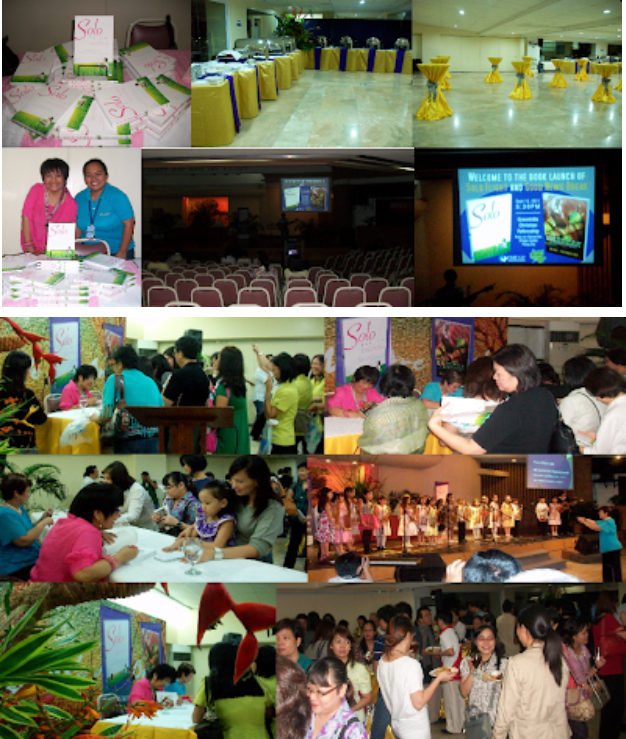
On September 15, 2011, Solo Flight (again, not solo, but in tandem with a book of Teacher Francie's husband) was launched.
The book launching was a story in itself. In one roof were as many singles as couples. Prepared by my co-author's staff, the ceremony was flawless (read: no dead air) and the mood, worshipful, turning festive at the reception!
This time, I will let the pictures tell the book launching story. But let me end this post by saying, grace makes everything possible—even the meeting of two most unlikely friends.
And the reason is, it was no solo flight for me, as it usually is when I write, till the manuscript reaches the editor(s).
For Solo Flight, I had a co-author.
It seemed like an accident at first, but reflecting on the events where Solo Flight began, I believe an unseen Hand led us all to it.
Teacher Francie, a nodding acquaintance for years, had a wonderful story to tell. In one of our chance encounters, she began to tell me this story, which left me unblinking. Unfortunately, the narration was cut short by the activity we were both attending. A brief thought came to me then—it would make an interesting book.
What do you know, Yna, OMFLit's Director for Publications, emailed a few months later, asking me if I wanted to partner with Teacher Francie in writing her love story. I jumped at the chance—to hear the ending of it—and as the say, the rest is history.
How does one deal with joint authorship? Deb Bataller of CBN Asia said it best, “Teacher Francie is the storyteller and Grace is the story writer.”
Writing someone's story from her point of view is deceptively easy. But the writer has to enter that someone's innermost thoughts—and fears. That's where the difficulty lies—having disparate feelings and opinions about issues. Teacher Francie was single for almost as long as I have been married!
Grace came to the rescue—it turned on the sunshine, so that both ends would see where to walk together towards the same destination.
As the writing went along, grace also brought in new dimensions and texture to give the story depth and relevance to singles. It branched out to other related stories. Then Yna and our editor, Beng (both singles), threw in fresh insights that enriched the writing even more.
On September 15, 2011, Solo Flight (again, not solo, but in tandem with a book of Teacher Francie's husband) was launched.
The book launching was a story in itself. In one roof were as many singles as couples. Prepared by my co-author's staff, the ceremony was flawless (read: no dead air) and the mood, worshipful, turning festive at the reception!
This time, I will let the pictures tell the book launching story. But let me end this post by saying, grace makes everything possible—even the meeting of two most unlikely friends.
10/15/2011
Angry Birds
The first time I heard these two words was about a week before Adrian arrived from the US. My friend G and I were shopping and she yelped when she found the perfect pair of ear phones for a little nephew. She uttered three unfamiliar syllables I couldn't catch.
“Antsy Birds?” I asked.
“Angry Birds!” she replied.
“Hardy words?” I asked again.
“Angry birds!” she replied, louder this time.
“Wordy curds?” I was really trying mighty hard to understand.
“A-N-G-R-Y, B-I-R-D-S!” she spelled them out, loud and clear. And she went on to explain what they were.
Not a fan of computer games, I had zero knowledge of these cyber creatures' existence.
Then Adrian, a cannonball at four, landed on our shores. He was to be left with Tony and me for four days while his parents took off somewhere.
On his first day alone with us, we brought him to a toy store. “What would you like Amah (Chinese word of respect for grandma) and Angkong (grandpa) to buy you, Adrian?”
“Angry birds!” he said excitedly
“Antsy birds?” “Hardy words?” “Wordy curds?” These series of questions came not from me but from his Angkong.
I patiently explained to the clueless senior what they were. To say he was shocked would be accurate. Not at Angry Birds, but at how well I knew what was supposed to be Greek to our generation.
It was a cinch from hereon. Wherever we went—to the playground, the restaurant, the mall, the video arcade, the flea market, Rizal's hometown, a provincial farm, a resort—my technologically challenged roommate and I could spot Angry Birds miles away.
Angry Birds mimicked grace—they were to our left, to our right, above us, below us, all around us. Countless. Endless.
We had not realized till then that these characters inhabit every single place and space these days—handbags, backpacks, umbrellas, hats, pencil cases, t-shirts, toys, ear plugs, posters, decals, you name it, Angry Birds are on it.
By the time Adrian's mom and dad were packing their luggage back to the US, they had to allocate one suitcase for Angry Birds—from both sets of grandparents.

Here's the thing. Adrian planed in as Captain America (and Green lantern, and Spider Man, and Iron man, and Captain Marvel, and everyone in the League of Super heroes), but flew out in less than three weeks as Angry Birds.
Whew!
Lord, thank you for the grace of a grandson who keeps us in the loop. Amen.
“Antsy Birds?” I asked.
“Angry Birds!” she replied.
“Hardy words?” I asked again.
“Angry birds!” she replied, louder this time.
“Wordy curds?” I was really trying mighty hard to understand.
“A-N-G-R-Y, B-I-R-D-S!” she spelled them out, loud and clear. And she went on to explain what they were.
Not a fan of computer games, I had zero knowledge of these cyber creatures' existence.
Then Adrian, a cannonball at four, landed on our shores. He was to be left with Tony and me for four days while his parents took off somewhere.
On his first day alone with us, we brought him to a toy store. “What would you like Amah (Chinese word of respect for grandma) and Angkong (grandpa) to buy you, Adrian?”
“Angry birds!” he said excitedly
“Antsy birds?” “Hardy words?” “Wordy curds?” These series of questions came not from me but from his Angkong.
I patiently explained to the clueless senior what they were. To say he was shocked would be accurate. Not at Angry Birds, but at how well I knew what was supposed to be Greek to our generation.
It was a cinch from hereon. Wherever we went—to the playground, the restaurant, the mall, the video arcade, the flea market, Rizal's hometown, a provincial farm, a resort—my technologically challenged roommate and I could spot Angry Birds miles away.
Angry Birds mimicked grace—they were to our left, to our right, above us, below us, all around us. Countless. Endless.
We had not realized till then that these characters inhabit every single place and space these days—handbags, backpacks, umbrellas, hats, pencil cases, t-shirts, toys, ear plugs, posters, decals, you name it, Angry Birds are on it.
By the time Adrian's mom and dad were packing their luggage back to the US, they had to allocate one suitcase for Angry Birds—from both sets of grandparents.

Here's the thing. Adrian planed in as Captain America (and Green lantern, and Spider Man, and Iron man, and Captain Marvel, and everyone in the League of Super heroes), but flew out in less than three weeks as Angry Birds.
Whew!
Lord, thank you for the grace of a grandson who keeps us in the loop. Amen.
10/10/2011
Palanca Awards 2011
This year's September 1 is a season of smiles, I thought, noticing for the first time that everyone I met inside the ballroom of Manila Peninsula Hotel had a grin glued on his face.
Well, the Don Carlos Palanca Memorial Awards Night is a happy occasion. The winners are given their certificates/medals on stage.
Now on its 61st year, the Palanca Awards remains, as written on its website, “The country's most prestigious and longest-running literary contest.”
Receiving your certificate/medal takes no more than two minutes. But it makes you feel like you're floating on air far more than that.
I glimpsed some of the biggest smiles that night on stage where I stayed for two minutes—times six. As chair of the jury for the Kabataan Essay category in both Filipino and English, I was privileged to hand out the first, second, and third awards in both divisions.
My friend, Dr. Luis Gatmaitan, a Hall of Fame Palanca awardee and who had been invited to judge a number of times, whispered as I hurried up the stage, It's more exciting to go up there as a winner than as a judge.
I couldn't agree more. When I went up the stage for my awards on several Sept. 1's, I nearly tripped and my lips twitched here and there. But now having the reverse view on ringside seat, I saw how those near-trips and twitches really looked like—a glow that rivaled the spotlights.
But a judge had her share of excitement, too—of an unusual kind.
I felt humbled to be a part of a judging panel whose job was to separate the great from the excellent: a herculean task. After reading the entries over and over again, reveling in full adrenaline rush, you begin to doubt whether you are up to the task or are being fair.
Judging is personal taste. Put three judges together and there will be three points of view.
This is when one needs the grace of discernment. Human blinders make you lose your way.
After writing down my choices' strengths and weakness, I brought my notes to the judging table. Two other judges and I, after a lengthy discussion, agreed on the first, second and third prizes in both English and Filipino divisions.
I was blessed with two gentlemen peers who were as objective as objective can be. There were no names on the entries, just numbers, and the judges' identity were kept confidential. Every name was revealed only on September 1.
All below 18, the winners brimmed with optimism and idealism. (To read their winning pieces, please click.)
A bonus for me that night, aside from meeting the literary greats whose works I drool over and a huge souvenir medal, was talking for the first time to one of my revered Filipino authors, F. Sionil Jose, the guest speaker.
But just when I wanted to have a photo with him, my camera batteries conked out. Luis came to the rescue (95% of the photos on these page were taken by him).
“I pass through your town, Rosales, on my way to my own, sir, ” I babbled as an opener. “One time we drove around looking for the balete tree in your Rosales Saga.”
He laughed and rattled off in Ilocano, “Awan didiay! [That tree is non-existent!]” A fact I had already known from write-ups of him, yet it made for good conversation with a National Artist whose literary achievements stun.
So I got my pictures, which I am sharing with you.
Looking at them, I think I imbibed the winners' smiles—especially because when Tony and I left the hotel that night, this verse illumined my mind anew:
“. . . as God’s grace reaches more and more people, there will be great thanksgiving, and God will receive more and more glory.” 2 Corinthians 4:15 (NLT)
Well, the Don Carlos Palanca Memorial Awards Night is a happy occasion. The winners are given their certificates/medals on stage.
Now on its 61st year, the Palanca Awards remains, as written on its website, “The country's most prestigious and longest-running literary contest.”
Receiving your certificate/medal takes no more than two minutes. But it makes you feel like you're floating on air far more than that.
I glimpsed some of the biggest smiles that night on stage where I stayed for two minutes—times six. As chair of the jury for the Kabataan Essay category in both Filipino and English, I was privileged to hand out the first, second, and third awards in both divisions.
My friend, Dr. Luis Gatmaitan, a Hall of Fame Palanca awardee and who had been invited to judge a number of times, whispered as I hurried up the stage, It's more exciting to go up there as a winner than as a judge.
I couldn't agree more. When I went up the stage for my awards on several Sept. 1's, I nearly tripped and my lips twitched here and there. But now having the reverse view on ringside seat, I saw how those near-trips and twitches really looked like—a glow that rivaled the spotlights.
But a judge had her share of excitement, too—of an unusual kind.
I felt humbled to be a part of a judging panel whose job was to separate the great from the excellent: a herculean task. After reading the entries over and over again, reveling in full adrenaline rush, you begin to doubt whether you are up to the task or are being fair.
Judging is personal taste. Put three judges together and there will be three points of view.
This is when one needs the grace of discernment. Human blinders make you lose your way.
After writing down my choices' strengths and weakness, I brought my notes to the judging table. Two other judges and I, after a lengthy discussion, agreed on the first, second and third prizes in both English and Filipino divisions.
I was blessed with two gentlemen peers who were as objective as objective can be. There were no names on the entries, just numbers, and the judges' identity were kept confidential. Every name was revealed only on September 1.
All below 18, the winners brimmed with optimism and idealism. (To read their winning pieces, please click.)
A bonus for me that night, aside from meeting the literary greats whose works I drool over and a huge souvenir medal, was talking for the first time to one of my revered Filipino authors, F. Sionil Jose, the guest speaker.
But just when I wanted to have a photo with him, my camera batteries conked out. Luis came to the rescue (95% of the photos on these page were taken by him).
“I pass through your town, Rosales, on my way to my own, sir, ” I babbled as an opener. “One time we drove around looking for the balete tree in your Rosales Saga.”
He laughed and rattled off in Ilocano, “Awan didiay! [That tree is non-existent!]” A fact I had already known from write-ups of him, yet it made for good conversation with a National Artist whose literary achievements stun.
So I got my pictures, which I am sharing with you.
Looking at them, I think I imbibed the winners' smiles—especially because when Tony and I left the hotel that night, this verse illumined my mind anew:
“. . . as God’s grace reaches more and more people, there will be great thanksgiving, and God will receive more and more glory.” 2 Corinthians 4:15 (NLT)
10/07/2011
Steve Jobs and Manong Arsenio
While the world is grieving the passing of Steve Jobs, I am privately mourning the death of someone nobody knew but his family and friends.
I called him Manong (Ilocano honorific for an older male) Arsenio—he who married my childhood friend and worked with his hands all his life on an insignificant farm, hidden in the middle of nowhere.
Steve never heard of Arsenio, neither did Manong Arsenio ever hear of Steve.
The cyber community is abuzz with beautiful words—tribute after tribute—for Steve. No techie worth his pixels can ever say enough about this modern icon, dead at 56.
No words will ever be written about Manong Arsenio, 71. His friends and family can't write prose nor poetry.
Steve was the reason millions of people joined the computer industry, or even care about technology at all. Yes, he made the computer personal, and the smartphone fun.
Mankind always awaited with bated breath another revolutionary product from Steve—the iMac, OS X, the iPod, iTunes, the iPhone, the iPad. These products have made their homes in many work rooms, family rooms and bedrooms.
Manong Arsenio didn't own a computer, simply because he had no need for one. To communicate with someone, he walked the distance. On Sundays, he donned his best for the worship service, where he awaited with bated breath the next lesson about Jesus from the pastor and his Sunday School teacher. On weekdays, he helped with odd jobs in church.
While Steve walked on the spotlit stage with his iMac in a brown envelope, Manong Arsenio toiled under the heat of the sun with a spade, mixing cement for his church's walkway.
While Steve addressed raucous crowds to launch the latest invention of his extraordinary brain, Manong Arsenio rallied a small group of timid elders and deacons to make do with available funds to re-build the church ravaged by Typhoon Ondoy.
When Steve was diagnosed with cancer, he got the best medical care from the best physicians in the best hospitals; Manong Arsenio opted not to undergo further treatment because he couldn't afford the expensive dialysis and medicines.
Many of Steve's fans are cursing—in unprintable words—the disease that killed him. All of Manong Arsenio's family and friends, although in grief, are praising God for the blessed life he lived.
This is a world of contrasts.
Without meaning to cast judgment on the two men, who both touched my life, I think the difference lies not in their status in society—how much money they amassed, how much education they earned, or how many people lionized them.
It's in how they acknowledged the Source of what they were and what they had.
From what I read, Steve Jobs (or the people who admired him anyway) believed he had it all in him—a creative genius.
From what I know, Manong Arsenio (or the people in his circle anyway) believed that everything is by grace. And he was exceedingly grateful to the Source of this wondrous grace all his life, till his very last breath.
Goodbye, Steve; till we meet again, Manong Arsenio.
I called him Manong (Ilocano honorific for an older male) Arsenio—he who married my childhood friend and worked with his hands all his life on an insignificant farm, hidden in the middle of nowhere.
Steve never heard of Arsenio, neither did Manong Arsenio ever hear of Steve.
![]() |
| (Left) Steve Jobs with one of his babies on stage; (left) Manong Arsenio with his wife at his home |
No words will ever be written about Manong Arsenio, 71. His friends and family can't write prose nor poetry.
Steve was the reason millions of people joined the computer industry, or even care about technology at all. Yes, he made the computer personal, and the smartphone fun.
Mankind always awaited with bated breath another revolutionary product from Steve—the iMac, OS X, the iPod, iTunes, the iPhone, the iPad. These products have made their homes in many work rooms, family rooms and bedrooms.
Manong Arsenio didn't own a computer, simply because he had no need for one. To communicate with someone, he walked the distance. On Sundays, he donned his best for the worship service, where he awaited with bated breath the next lesson about Jesus from the pastor and his Sunday School teacher. On weekdays, he helped with odd jobs in church.
While Steve walked on the spotlit stage with his iMac in a brown envelope, Manong Arsenio toiled under the heat of the sun with a spade, mixing cement for his church's walkway.
While Steve addressed raucous crowds to launch the latest invention of his extraordinary brain, Manong Arsenio rallied a small group of timid elders and deacons to make do with available funds to re-build the church ravaged by Typhoon Ondoy.
When Steve was diagnosed with cancer, he got the best medical care from the best physicians in the best hospitals; Manong Arsenio opted not to undergo further treatment because he couldn't afford the expensive dialysis and medicines.
Many of Steve's fans are cursing—in unprintable words—the disease that killed him. All of Manong Arsenio's family and friends, although in grief, are praising God for the blessed life he lived.
This is a world of contrasts.
Without meaning to cast judgment on the two men, who both touched my life, I think the difference lies not in their status in society—how much money they amassed, how much education they earned, or how many people lionized them.
It's in how they acknowledged the Source of what they were and what they had.
From what I read, Steve Jobs (or the people who admired him anyway) believed he had it all in him—a creative genius.
From what I know, Manong Arsenio (or the people in his circle anyway) believed that everything is by grace. And he was exceedingly grateful to the Source of this wondrous grace all his life, till his very last breath.
Goodbye, Steve; till we meet again, Manong Arsenio.
10/04/2011
Simple Folks
JB called from the US a week before his and his family's short three-week trip to the Philippines.
"Mom, what would you want me to buy you from here?"
He gave me the perfect opening to ask for the moon.
Without missing a beat, I said, "Philip Yancey's latest book, What Good is God?" (I have all of this author's books, each one of them signed by Yancey himself.)
Pause. "That's it?!" he asked, surprised.
"That's it," I replied.
"But you could easily download that to your Nook [his gift last Christmas]!"
"It would be nice to have this book in print."
Resigned sigh. "Anything else?" he pressed.
"Nothing else."
A more audible resigned sigh, “Ok.”
Days earlier, he chatted with JC, asking him what their father might want.
JC typed, “Prince Valiant comic book.”
JB: Huh?! How about an iPad 2?
JC: No, Prince Valiant. He's been nagging me to order for him the Vol. 3 collection from Amazon.”
JB: How about a high-tech razor?
JC: Prince Valiant.
Tony and I—we're simple folks. When generous cousins from abroad ask for what we want when they visit, we say, "Splenda."
"Splenda?! That thing available in any supermarket?!"
"Yeah, but we want the freebies on the plane."
"Huh?"
Over the years, and more than ever now that we are headed toward the sunset, the Lord has helped us pare down our expensive wants so we can enjoy the free things He has given us—the sky and all that's in it; the earth and all that's in it; the air and all that's in it; ample breaks to use the talents sent our way, and doing what we love doing; relationships, friends, family; the time to praise, worship, and thank Him for every blessing—most especially His greatest gift of all:
The grace of redemption.
"Mom, what would you want me to buy you from here?"
He gave me the perfect opening to ask for the moon.
Without missing a beat, I said, "Philip Yancey's latest book, What Good is God?" (I have all of this author's books, each one of them signed by Yancey himself.)
Pause. "That's it?!" he asked, surprised.
"That's it," I replied.
"But you could easily download that to your Nook [his gift last Christmas]!"
"It would be nice to have this book in print."
Resigned sigh. "Anything else?" he pressed.
"Nothing else."
A more audible resigned sigh, “Ok.”
Days earlier, he chatted with JC, asking him what their father might want.
JC typed, “Prince Valiant comic book.”
JB: Huh?! How about an iPad 2?
JC: No, Prince Valiant. He's been nagging me to order for him the Vol. 3 collection from Amazon.”
JB: How about a high-tech razor?
JC: Prince Valiant.

Tony and I—we're simple folks. When generous cousins from abroad ask for what we want when they visit, we say, "Splenda."
"Splenda?! That thing available in any supermarket?!"
"Yeah, but we want the freebies on the plane."
"Huh?"
Over the years, and more than ever now that we are headed toward the sunset, the Lord has helped us pare down our expensive wants so we can enjoy the free things He has given us—the sky and all that's in it; the earth and all that's in it; the air and all that's in it; ample breaks to use the talents sent our way, and doing what we love doing; relationships, friends, family; the time to praise, worship, and thank Him for every blessing—most especially His greatest gift of all:
The grace of redemption.
Subscribe to:
Posts (Atom)