3/27/2015

In the Same Boat

This idiom was first used by the ancient Greeks, referring to the risks shared by all passengers in a small boat at sea. Through time, the meaning came to include all people in similar, unpleasant circumstances at sea, on land, or in the air.

Let me go back to its origin to distil the complicated concept of life storms.  

These are problems that assault us, making us feel as though we’re sinking, drowning, being beaten by the swirling waters and turbulent tides in the deep blue sea.

In such situations, we desperately call out to God for help.

When the problem continues to rip us apart, we ask, "Are you sleeping, Jesus?"

Jesus was indeed sleeping!  

In a boat with His disciples, Jesus was asleep, unmindful of the dangers that lurked around them.

"But soon a fierce storm came up. High waves were breaking into the boat, and it began to fill with water . . . The disciples woke him up, shouting, 'Teacher, don’t you care that we’re going to drown? 

“When Jesus woke up, he rebuked the wind and said to the waves, 'Silence! Be still!'  Suddenly the wind stopped, and there was a great calm.

“Then he asked them, 'Why are you afraid? Do you still have no faith?'”

If you were in the same boat, wouldn't you be afraid, too? The possibility of drowning and dying is terrifying. 

But ah, Jesus was in the same boat, too!  The same boat being battered by waves and wind.

How easily we forget that when we suffer through harrowing experiences, He is with us. He will not allow us to sink; He calms the waves and wind.

But in truth, the real storm is not what's outside of us, but what is within us—fear. It’s gnawing fear that makes the situation seem worse; it’s our inner turmoil that needs calming.   

Jesus asks, "Do you still have no faith?"

Jesus is in the same boat. And if He is, should we be fearful? Should we even worry?

May His grace continue to steady and strengthen our fledgling faith. 

(Quoted verses: Mark 4:37-40 NLT)

Photo credit: Painting by Ludolf Bakhuizen, 1695

3/23/2015

Kenosis

I've been blessed with two wise, thinking bosses, from whom I have learned a lot.  (I omit from this post the creative, unstructured ones who honed my right brain.) 

The first, ABAJA, often turned on the light for me when I was still in the corporate world. Much of how my left brain behaves today I credit to him.

The second, Leo, is also a switchman. He regularly clicks the “on” of my academic light bulb.

He opened my eyes to the word kenosis. “Emptying,” he said.
 
We were talking about problem students—those whose plates are full with too many issues, all big in their mind, and therefore have no space even for a small serving of classroom lessons.

“Only when one’s mind is emptied of issues can he listen again,” he said. Those were not Leo's exact words, but that was the lesson I chose to learn.

This flashed back to my first guru. Before he retired he said, “I don't want to be somebody anymore. I just want to be nobody.”  From his FB posts, I have no doubt that emptying has done him wonders. 

Christians believe that self-emptying is the ethic of Jesus. He waived all privileges in His place of glory so He could be with us, like us, on earth. This self-sacrifice was for the redemption and salvation of all humanity.

Apostle Paul in fact urged the Philippians to imitate Christ's self-emptying. He issued a call for humility and for Christians to imitate Christ. “. . . he gave up his divine privileges; took the humble position of a slave and was born as a human being. When he appeared in human form, he humbled himself in obedience to God and died a criminal’s death on a cross.” Philippians 2:7-8 (NLT)

Uncanny how two bosses from two different worlds speak of kenosis—one in a corporate arena; the other, in an academic hub.  

Is it at all possible for modern man to be Christ-like and empty himself of worldly trappings and desires?

Only by grace.

3/19/2015

The Book, the Play, the Joy

The book: 

Originally written in English, No Lipstick for Mother won first prize in the Palanca Awards 2005.  It was re-told in Filipino by my friend, Dr. Luis P. Gatmaitan, a Palanca hall-of-fame awardee and a well-loved children’s book author.  

Both book versions (illustrated by Kora Dandan-Albano) have since delighted hundreds, hopefully thousands by now, of young readers here and abroad.

I wrote it to empower women. It focuses on the outer beauty that the world acknowledges (symbolized by lipstick) versus the unfading inner beauty God wants women to cherish.

March being National Women’s Month in the Philippines, I thought it might be relevant to re-visit the book.    

The Play:

No Lipstick for Mother is now also a stage play! 

Not in English, not in Filipino, but in Cebuano.

It was produced in Cebu by Childlink Learning Center and Childlink High School Inc. Directed by no less than the school’s directress, Maria Theresa F. Tio, the play delighted young and old audiences alike.

I wish I had watched it. But Manila and Cebu are a flight apart. If only I had been able to conjure a magic carpet, I’d have turned myself into Aladdin. 

The Joy: 

Photos of the play arrived via email—images I would keep and treasure as priceless and precious possessions.

As soon as I saw them, I rose from my computer chair and gave the cast and crew a standing ovation.

Literature and drama are two different art forms. But what thrills me most about the book is that the story lent itself well to 3-D movements and songs, and that, aside from readers, it had been able to send the message to a live audience. 

Before March ends, may all my cyber friends be granted the grace of joy in celebrating National Women's Month.

"Don’t be concerned about the outward beauty of fancy hairstyles, expensive jewelry, or beautiful clothes. You should clothe yourselves instead with the beauty that comes from within, the unfading beauty of a gentle and quiet spirit, which is so precious to God.” 1 Peter 3:3-4 (NLT) 

3/15/2015

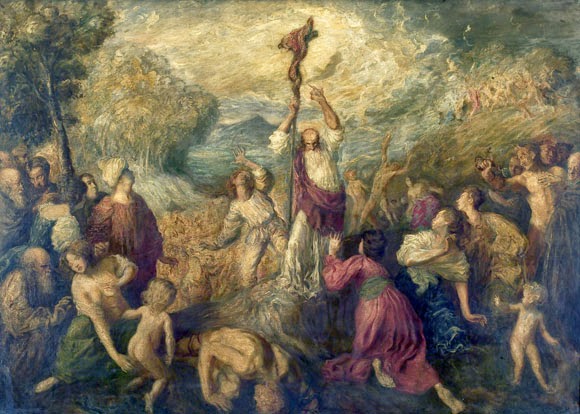
Serpent vs. Serpent

While reading my chronological Bible, I found a strange story that made me sit up, ponder and wonder. It’s found in Numbers 21:4-9.

The people of Israel complained again (for the umpteenth time) and God again (!) punished them.  Even after being severely punished over and over by God for past disobedience, they never learned their lesson.

This time, the Lord sent fiery serpents that bit people to their death.  

And as he did many times before, Moses begged the Lord to spare the people. God, in his infinite patience, again relented. He provided a very specific, odd remedy to save them.

God instructed Moses to make a fake fiery serpent made of bronze and set it on a pole. He said that anyone who looked at it will live.

Moses did just that.
 
Now, why would God use a serpent to save the people from the serpent? Why would He tell Moses to make an image of the very thing that was killing his people?

This must have been the same questions asked by some of the stubborn Israelites who simply refused to look—and died. 

But those who looked upon the bronze serpent with the eyes of faith lived, even as the serpent’s venom was already draining life from their bodies.

Many years later, however, the reigning king, Hezekiah, destroyed the bronze serpent after consultation with God. Why?

Over time, it morphed into an object of idolatrous worship—it had become a god. People burned incense before it and worshiped it, instead of God.  What was meant to be good was turned into evil.

That is the story of our lives.

In the beginning, Adam and Eve were given a paradise. But they believed a serpent more than God. Again and again, despite umpteenth chances, man keeps falling into evil ways.

That’s why over two thousand years ago, God gave sinful men the ultimate Grace on a cross: His only Son became sin so that through Him we will have a chance to be in paradise with God. 

Those who gaze upon that cross with the eyes of faith will be healed from the scourge of sin and live with Jesus forever.    

"God saved you by his grace when you believed. And you can't take credit for this; it is a gift from God.”  Ephesians 2:8 (NLT)

Photo: Moses and the Brazen Serpent, 1898, Augustus John (1878–1961), Oil on canvas

3/11/2015

Hibernating

Deposit it inside a drawer for hibernation . . . 
 
That's what I just did with the manuscript of my latest book.

This is the step in my writing that I take very seriously. This is also the time when I spend my time doing nothing except celebrating. Hence, as has been my ritual on this blogsite when I celebrate, my header changes:

From here . . .
To here . . .
Am I making sense?

Not at all, not to anyone.

This one's all about my personal writing process, which some people may find odd. 

After furiously writing for months—writing, re-writing, revising, re-revising, editing, re-editing, printing the draft, tearing it up, re-printing, editing again—I finally come to a version I am comfortable with. But before I send it to my editor, I send it to a drawer to hibernate for at least two weeks.

During such time, I forget about it.

After the silent two weeks, I read it again.

And I see them! Them are those errors or lapses that escaped me. How did I ever miss them? Duh. 

They glare at me saying, "Work, work, work some more!"

And I obey. I tweak and twist, push and pull all day, all night.  

Then off to my editor the manuscript goes, right on time for my deadline.

There are many more steps and more months before the manuscript becomes a book, if it all, but that's another saga I will blog about some other time.

Meanwhile, let me dwell in the grace of my manuscript's hibernation.

"With all my heart I will praise you, O Lord my God. I will give glory to your name forever . . ."  Psalm 86:12 (NLT)

By the way, in case you’re interested, my book's working title is "Present!"

3/07/2015

Big Best Breakfast

Have you been treated to a blast of blessings all at once?

I was. And I asked myself, What did I do to deserve this? 

Amidst months of busy, busy days, over the weekend Tony and I traveled to the place where I grew up, bringing along with us my best cuzzin Minna who was visiting from New York after a long while.   

The landscape has changed, like it always does when I make those rare trips home.  The new highway cut our traveling time down to half; instead of lean-tos, new Manila-like shops lined the streets. The dirt bends and the trees of my youth have aged beyond recognition. 

Yet, the fervor of family get-togethers remained the same. My siblings and their spouses, who likewise all went home for this impromptu cuzzin-welcome, met us with warm how-wonderful-to-see-you-again hugs, coupled with digital clicks.

We had grand activities like visiting a mountain resort and kunol-kunol (translation: chats with disjointed sentences and laughter on any topic that comes to mind), but none more magnificent than the big best breakfast that extended up to lunch before we said our good-byes. 

My brother Dave and his wife, Gladys, live in a manor with an herb garden for a backyard. There we spent the night and in the morning, we were surprised by an all-natural breakfast, with a platter of omelets courtesy of their duck farm—prepared with TLC by the two of them.

“Eat, eat,” I ordered our special guest, Minna, who, like me, was dazed by the array of food.

“My heart is full,” she said, digging in. 

Grace is like that. It feels your heart, my heart, even if I didn’t do anything to deserve it.

3/03/2015

How Intelligent Are You?

Intelligence is an extremely complex subject. 
 
There are IQ tests that measure intelligence, but debates are raging over their flaws.

In fact, Guinness retired the "Highest IQ" category in 1990 after concluding IQ tests are too unreliable to designate a single record holder.

But I am writing about two of those found with the highest IQs because I find them fascinating:  

One is a Korean named Kim Ung-yong, born in 1963, with an IQ of 210.

He started speaking at the age of six months and was able to read Japanese, Korean, German, English and many other languages by his third birthday.

At age four, he had memorized about 2000 words in both English and German. At age eight, he was invited by America’s NASA and conducted research work for 10 years. He also received a Ph.D in Physics at Colorado State University a few years later.

But at age 13, Kim was burnt out and returned to his homeland. He shocked everyone by choosing an ordinary office work. Apparently, people expected him to reach the moon. But he says, “I have found my bliss.”  

The other genius, James William Sidis, an American (1898-1944), was credited to have an IQ of 250-300. At age two, he could read English; at age four, he was typing original work in French. A year later, he had devised a formula to accurately name the day of the week for any given date. At eight, he projected a new logarithms table based on the number twelve.

James entered Harvard at age 12 and graduated cum laude.  By this time, he could speak and read fluently French, German, Russian, Greek, Latin, Armenian and Turkish.

At some point in his life, however, James said, “I am tired of thinking.” He took on obscure mechanical jobs that paid just enough for his subsistence.

The lives of these two geniuses show us that intelligence, like everything else we own on earth, does not bring on happiness or success. 

The road to eternal joy and pleasures is Jesus, the Grace birthed for us in a lowly manger thousands of years ago. Without Grace, all that we have on earth burns out. 

“You make known to me the path of life; you will fill me with joy in your presence, with eternal pleasures at your right hand.”  Psalm 16:11

Photo credit: smitsonianmag.com 

2/28/2015

God Doesn’t Make Sense

Even to hard-core believers, sometimes God doesn’t make sense.  

This, in essence, was what I gleaned from our pastor’s message one Sunday. I nodded so hard the pew shook and my head almost came off my neck.

Why would a God Who loves us, Who came down His throne to save inconsequential us from our sins, allow senseless things to happen?

Why would God allow 44 police (SAF) to be massacred by heartless murderers?

Why would God allow pastors and missionaries to be persecuted and killed?

Why wouldn’t God answer the prayers for peace in war-torn countries?

And the most shuddering news in recent days—the barbaric beheading of 21 Christians by the ISIS. Why would God allow His children’s innocent blood to spill into the sea?

From accounts of those who witnessed the savage execution, the helpless victims were repeating the words “Lord, Jesus Christ.” Some screamed “Yeshua!”

When Pope Francis visited the Philippines recently, a 12-year-old girl asked him through her tears, “Why is God allowing [bad things] to happen, even to innocent children?”

The head of over 1.2 billion Roman Catholics was stumped. Visibly moved, he had no answer. He could only say, “Only when we are able to cry are we able to come close to responding to your question.”

Humans have finite minds, and because we think simply, we can’t even begin to approximate God’s thoughts. In Isaiah 55:8, we read, "‘My thoughts are nothing like your thoughts,’ says the LORD. ‘And my ways are far beyond anything you could imagine.’”

No, we can never imagine the boundless grace that comes to us every second of every day. That’s why we don’t thank Him enough. Our simple minds simply can’t fathom the sense of many things happening to us.

We, hard-core believers in His unconditional love, with the faith of a child, can only trust, simply trust. 

2/24/2015

Computer with a Heart

Mothers might have invented the term “multitasking" long before it made its way to the dictionary.

From pregnancy to childbirth, until such time that our children can do things on their own, we hover around, busy with every task at home and at work (for working moms), dividing 24 hours and seven weeks into productive moments employers could only dream of.  

From my quick research, I discovered that the term “multitasking” was first used in a mechanical context in 1966 when technology began to dictate our way of life. It originated from the computer engineering industry, referring to the ability of a microprocessor to process several tasks simultaneously. 

Computer multitasking in single-core microprocessors involves time sharing. Only one task can actually be active at a time, but tasks are rotated every second.  Therefore, with the invention of multi-core computers, each core can perform a separate task simultaneously.

Sounds familiar? 

Yes, moms are like multi-core computers who can perform many tasks simultaneously. But, ah, there’s a big difference. A computer only has a “brain” created by humans.

It has no heart.

Moms have a heart—an extra-large one, if we go by sizes. We operate by and with that four-letter word called “love.”

How else can one work all day in the office and then come home to help her kids with their homework, put them to bed with a story, and sleep lightly at night so she could hear every unusual sound from the little ones? 

Then she wakes up at dawn to make sure that the kids have their “baon” and are ready for school. While in the office, she constantly calls home to check with the yaya (baby sitter) how things are going.

How about the food—groceries and meals? She plans those, too. And the house guests who hop in sometimes? How about when the kids get sick? Or have a special event in school? And her duties in her church and community? She juggles time between work, community, church, and school. 

Daunting chores!  

Then there’s her husband. And her home. They both need time—the husband, of course, gets the bigger share of caring.

My friend, Malou, has no house helper and her husband is an OFW. So she has to be both father and mother to their three kids.

Once I invited her to coffee and she told me about her jam-packed daily schedule. “Between my kids, their school, and our home, I am blessed to have this relaxing time.”  

After she narrated her typical day, I panted from exhaustion. “I got so tired just listening to your activities. You’re a super mom!” I said, meaning it. “How do you do it?”

“Through the art of multitasking,” she replied. 

“Art?! You have elevated multitasking to an art? But it’s the science of time management and multiple duties,” I replied, amazed.

She giggled. 

For moms, multitasking is a no-brainer. It has to do with the heart—a gift of grace from the Master Multitasker Who created the earth and everything in, over, around and under it.  

(Adapted from my column “Happy endings” in Moms and Kids Magazine) 

2/20/2015

Big Brother and Down Syndrome

February, the shortest month of the year, unpacked big events in succession: Valentine’s day; Chinese New Year; International Book Giving Day; and lest we forget . . .

February is National Down Syndrome Consciousness Month in the Philippines.

Many people are aware of Down Syndrome (DS) as a condition that afflicts one in 800 live births in the world. But not many know that children with DS, God's special blessings, possess great potential to live normal lives.

That’s why Republic Act 157 proclaimed February as National Down Syndrome Consciousness Month, under the auspices of the DSAPI:
 
It is to give Filipino children with DS "a mantle of protection against abuse, violence, and indifference." Like you, me, and every citizen, they deserve dignity and respect. 

These were the least we could do for my cousin Tinoy, born with DS.

He could speak only a few words and remained a child, but his parents never looked at him any differently. They were as proud of Tinoy as they were of their other children.

He was not kept at home, hidden from the world. This unconditional treatment rubbed off on everyone who ever met Tinoy—kith and kin alike.

In my visits with Tinoy when he and I were children, I taught him one word, ibon (bird), because he loved watching birds in flight. It took lots more visits and lots more practice before he could say, “uh-i-i-bon.”

What delighted me no end was, every time I’d see him (even a year or two apart), he would come to me and say, “uh-i-i-bon” and point to the sky.

These wonderful grace-encounters with Tinoy inspired the writing of “Big Brother” many years later, even if distance, time, and eventually his early death came between us.
 
“Big Brother,” a Palanca award winner and illustrated by Beth Parrocha-Doctolero, is a book of thanksgiving for the lives of Tinoy and every child born with DS.

It’s also a plea for those who’d chance upon the book to give kids with DS a chance to live full and decent lives.

I have always believed and felt, deep in my heart, that they could understand and feel more than we think they can—even if they remain as children while we grow up.

(Big Brother is available in all Philippine bookstores. It may also be ordered online through omflit.com)

2/19/2015

A Red-letter Day

Happy New Year. Gong Xi Fa Cai!

In the restaurant where we dined last night, New Year's eve, about 99% of the people were wearing red. The décor was all in red, too.

The occasion was indeed a red-letter day—a term that dates back from the 1400s. It those days, peopled marked feast days and other holy days in red on church calendars. Today, holidays are marked red in most calendars. 

Aside from being a red-letter day, Chinese New Year is dominated by the color red because red is considered the luckiest color in China. It is associated with happiness and good fortune; it symbolizes fire, believed to ward off evil spirits.

If you ever attend a Chinese celebration, wearing something red is always a good decision.

During these celebrations, one will not miss seeing the Ang Pao. In fact, my children, when they were little, looked forward to receiving them. These are little red envelopes stuffed with crisp new bills. They are given by the older family members as a gift to the young ones.  

As a token of appreciation, household staff and employees are sometimes also given Ang Pao as rewards for a job well done!

And speaking of red-letters days, wedding is one of them.

In Filipino weddings, the bride wears white. But in most Chinese weddings, the bride wears a traditional Chinese wedding dress in red.

Funny how one color could dictate one’s way of looking at life. Time and again, I’ve blogged about how superstitions can warp one’s mind, taking it away from the Source of grace.

I’ve always believed that no color, no omen, no sign, no nothing, no feng shui, and no luck can ever take the place of the love of God, from Whom all things (prosperity and happiness) flow.

The only red that is significant for me is the blood of Jesus—that which was shed for us so we may have life eternal, after this one has ended. 

Thank you, Lord, for this New Year.

“What shall we say about such wonderful things as these? If God is for us, who can ever be against us?” Romans 8:31 (NLT)    

2/14/2015

Love is in the Air

That’s the theme of the Valentine’s event where I was invited to speak. It’s been dubbed the love banquet.

What is there to talk about on such occasions? I’ve gone past romantic love many decades over. In fact, I’ve grown cynical about this whole February 14 hoo-ha. After many years in advertising, the culprit in the wild spending and revelry happening today, I have learned to let the day pass by with nary a care.

And now to speak about it?!

Romantic love, as the world knows it, is a far cry from the love written in Scripture.

Love, as Jesus demonstrated with his life, which culminated in His death on earth, can never be replicated. Not even if we try and try.

“Love keeps no record of wrongs,” He says in 1 Corinthians 13: 5.  Yet here I am writing about everything that’s wrong about today, when love is supposed to be celebrated. 

I am shamed by this verse and all the other verses that run through that beautiful love chapter. 

Love indeed is in the air. It is in the air we breathe. Without it, we have no life.

Each time we inhale life-giving air, we breathe in God's love through His grace—unassailable proof that despite our failings and wrongs, the Lord still freely gives us this air that we need to survive.  

That is the single message I wish to leave those who will attend the love banquet, which includes me. Because love is in the air, we could celebrate love today, tomorrow, and all the many tomorrows thereafter—'til we breathe no more. 

Give Someone a Book

Since I took up writing as a second career, I have shunned buying gifts other than books. Not all enjoy books as much as I do, but the delight in giving them is immeasurable. 

And today is another opportunity to give someone(s) a book. It’s International Book Giving Day! 

I chose to give the first book in the Oh, Mateo! series (Half and Half) to Rose.

She is no longer a child, she is all of 25, with a husband who left her, and three children. When she came to live with us as Ate Vi’s (our househelp of over 30 years) assistant two weeks ago, I found out that because of an extremely hard life, she barely finished third grade.  

Rose has a difficult time reading, but she is a survivor. She could text, is street smart, and knows her way around. When I invited her to church last Sunday, she cried during our Pastor’s sermon. She said she realized that despite her enormous problems, she is still here today, intact, because of God’s grace. 

Tony suggested that the best gift we probably could ever give Rose is to share with her my children’s books to read, one at a time, with the hope that she will begin to have a hint of the childhood she never had.

She breezed through the Filipino text, but she gave up on the English text. Ate Vi is encouraging her to read syllable per syllable. Eventually, I am sure, she would catch on.

We who are exposed to books take these printed gems for granted. But there are many others, those in far-flung places all over the country, who, like Rose, have no access whatsoever to anything readable. 

As we celebrate International Book Giving Day today, may we find it in our hearts to give someone a book.

Heart Diet

Let's go on a heart diet today, the day of hearts. It's good for, well, our heart.

(And for me, it's kind to my tummy, too.)        


2/10/2015

February Is Her Name

There is a girl named February—probably the only person on earth named such. However, she wants to be called Febe, instead of February. 

Nobody knew her real name, except her parents and close relatives, of course. But now, add to the list her grade school principal, who had read her birth certificate.

“Why don’t you want to be called February?” she asked.

“Because I wasn’t born in February! I was born in November.” 

“Would you rather be called November, then?” the principal smiled.

“Yes,” she said.  “But Febe is okay.”

Febe was named February because her parents met on February 14, Valentine’s day. It was a special day, so they named their first-born after this special month.    
Every February 14 (exactly four days from now), in many parts of the world, flowers, cards, gifts, and other goodies are exchanged between and among loved ones, in the name of St. Valentine.

You probably know the legend, but let me tell you anyway.  Long, long ago, Valentine, a priest of Rome, was imprisoned for performing weddings for soldiers who were forbidden to marry and for ministering to Christians, who were persecuted under the Roman Empire.

In jail, Valentine healed the daughter of his jailer. Before he was executed, he wrote his jailer’s daughter a letter signed "Your Valentine" as a farewell.

Just like Valentine’s Day, the name February has many legends and myths on how it came to be. But in truth, the word February comes from the Latin word februa, meaning “to cleanse.” This was a Roman festival of purification or Februalia. It was a month when people were ritually washed to be forgiven of their sins.

As of this writing, people are already busy shopping or planning parties. On the 14th, restaurants will be filled, flower shops will sell a lot of flowers, and chocolates in red packaging will flood the stores. Valentine Cards will be sent via email or on social media. 

“Everybody celebrates your name!” Febe’s school principal said when the calendar hit February.

“But it is not my birthday!”  Febe insisted. 

“My name is Doreen and nobody celebrates it,” the principal explained. “You’re blessed to have a name that is celebrated by everyone. Thank God for this grace."

After a brief pause, Febe declared, “My name is February!”

(Adapted from my column “Big Little People” published in The Freeman on February 8, 2015.) 

Photo credit: http://www.sensfoundation.com/

2/06/2015

Imperfect love

She requested me to arrange their meeting after 40 years. She was a balikbayan from the US; he never left Philippine shores.

“When I saw him again, the 40 years disappeared,” she confided to me later. She looked like a lovestruck teenager.

“When I saw her again, the 40 years disappeared,” he admitted as much separately. He was visibly smitten.  

They were only in their 20s forty years ago—so young and so in love. So they got married before she flew to the US. She discovered that as a nurse, she had a bright future there. Deciding to stay and not to come back home, she tried to convince him in her letters to follow her.

He loved his job as a Navy officer in the Philippines. He asked her to come back, but she wouldn't.

No one budged. Years passed and they both “married” other people, and each had children of his/her own. More years passed and through Facebook they met each other again: she is now a widow and he, a widower.

Perfect ending to Love is lovelier the second time around?

Not quite.

Before the Facebook encounter, he had entered into a relationship with another woman. And in the meeting I had arranged for them, he told her about it. 
 
She was heartbroken—again. “We need to have our marriage annulled then,” she suggested.  With the annulment, the last encumbrance in their relationship would be severed forever.

He refused. So she flew back to the US desolate. He was left pining for her; he didn't want to lose her the second time around, but he also couldn't afford to hurt the girl with whom he has a relationship now.

Are marriages made of these? Is this what love is about?

As we celebrate what the world has dubbed the "month of love," February, may we ponder the love shown to us by Jesus, our Lord of grace: 

“If I speak in the tongues of men and of angels, but have not love, I am a noisy gong or a clanging cymbal. And if I have prophetic powers, and understand all mysteries and all knowledge, and if I have all faith, so as to remove mountains, but have not love, I am nothing. If I give away all I have, and if I deliver up my body to be burned, but have not love, I gain nothing. Love is patient and kind; love does not envy or boast; it is not arrogant or rude. It does not insist on its own way; it is not irritable or resentful; . . .”   1 Corinthians 13:1-13 (ESV)

(Adapted from my book, 'Circle of Compassion,' published by OMF Lit in 2013)   

2/02/2015

Stage Mother

Gloria (not her real name) had a dream: to be a movie actress like Vilma Santos.

She had the looks and a natural flair for acting.

Unfortunately, a series of unfortunate events prevented her from pursuing her obsession until marriage finally wrote finis to her dream.  

When she had a daughter of her own, she was determined to fulfill her dream through her child. She hired a private acting coach for Gloria Jr. and spent much of her time telling her daughter how wonderful it was to be an actress.

Every summer, Gloria would lug her daughter to many movie studios and advertising agencies for videotaping. She also had tons of photos of her daughter in various costumes and poses.

Gloria Jr., however, neither had the looks nor the acting talent of her mother. She also loathed what her mother had been trying to ram down her throat. But as a dutiful daughter, she went along with her mom's plans—for years. 

One day, a brutally frank talent scout told Gloria, “Sorry, 'Day, but I don't think your daughter has an ounce of acting talent.”

Gloria cursed; Gloria Jr. rejoiced.

After finally realizing the futility of it all, Gloria asked her daughter, “If you can't be an actress, what is it you want to be?”

Gloria Jr., now 15, replied brightly, “An architect!”  

We can’t live our dreams through another person, not even if she is our own child. Each of us is made differently, given different gifts through grace.

Looking back, I am grateful to my parents for not imposing their dreams on me. My dad was a lawyer and my mom was a pharmacist, both active in politics. I am into the arts; not interested in any political post. That's precisely why today I am doing what I like best: writing.

Like Gloria, who learned her lesson well (albeit slowly), may we remember this about our children:  

"Behold, children are a heritage from the Lord, the fruit of the womb a reward. Like arrows in the hand of a warrior are the children of one's youth. Blessed is the man who fills his quiver with them! He shall not be put to shame when he speaks with his enemies in the gate." Psalm 127:3-5 (ESV)
   
(A portion of this post has been excerpted from my book, “Circle of Compassion,” published by OMF Lit in 2013)

1/29/2015

Bitter Hatred

For me, one the most stirring books about a father-son relationship ever written in modern history is “Dear Father, Dear Son” (Two lives . . . Eight hours) by Radio/TV talk show host Larry Elder.
Without giving the content away, let me touch on the back story, which Elder shares in his interviews.

He held a bitter hatred for his father, a Marine and a tough man with a difficult, dirt-poor past. Elder feared him so much he vowed to stand up to him one day.

He did when he was 15. They fought and Elder didn't speak to him for 10 years! 

At age 25, Elder felt restless, had difficulty sleeping and eating. A friend suggested that maybe the unresolved issues with his father were causing these. So Elder sought out his dad, thinking they would talk for only five minutes—say the worst things to each other—and done.  

Instead, they sat on two stools from 2:30 until 10:30 PM. In those eight hours, the father morphed from an ill-tempered, cruel ogre to a kind, caring inspiration. This is what the mesmerizing book is all about. “I completely misread him,” Elder lamented.   

“Dear Father, Dear Son,” according to critics, is a handbook for life: a story of a son searching for what he thought was a missing father, but who has been there all along.

The Father of all is in our midst, He is not missing at all. But many people today are missing His presence, because they deny the grace offered by the Son.

But to those who believe, it is all too clear, “I am the way, the truth and the light,” he said before He went back to His rightful place in heaven. “No one comes to the Father but through me.” (John 14:6)

(An excerpt from my book, Circle of Compassion, published by OMFLit)

1/25/2015

Voice Activated

When my brother Matt arrived from babysitting his grandson in the US, he regaled us with stories of his interesting domestic chores. For six months, he took care of nappies, milk, and other needs of an infant while his daughter and son-in-law worked full-time.

An American neighbor remarked, “Filipinos are so blessed. I wanted my parents to help with my baby, too, so I sent them two plane tickets. They sent them back!”

Babysitting was a role my brother relished, including working with his hands, relying on no one but himself. “I also enjoyed shoveling the snow; it kept me fit.”

This lifestyle is so different from the Philippines’ which, he said, is “voice activated.”  

Here, if you need something done. just call out:

“Water please!”

“Pick me up at noon, okay?”

“Open the gate.”

“Bring me my briefcase.”

“Take over drying the dishes." 

Household helping hands will do your bidding.

Countries differ culturally, but, how wonderful that grace abounds in all! We can taste and see this grace by acknowledging and being grateful for it.  

“Taste and see that the LORD is good. Oh, the joys of those who take refuge in him!” Psalm 34:8

(This is one of the 365 entries in my book "Gace@Work" published by OMFLit.)

1/21/2015

Pastor Moe

In a clear, distinct voice and impeccable diction, Pastor Moe—already an authoritative and a riveting speaker in his 20s—tackled Psalm 90, penned by his namesake, Moses. 

He had barely started when many of us in the pews wiped our eyes, not only because of his powerful message, but because of what he has become.

I am one of those who saw Pastor Moe from childhood to college, under the wings of his grandmother, a faith sister—who did a precarious balancing act of both a strict parent and a doting lola.

Reared in Sunday school, Pastor Moe was smart, with his share of adventures typical of boys his age. He was enrolled in Christian schools until high school and excelled throughout. 

It was when he went to college, where crossroads are found, that he turned truant—not caring whether he was coming or going. This caused his lola and family heartaches.

But somewhere down the road, an unseen Hand led him to a Bible school away from home. There, Moe was not exactly a saint, taking for granted the support and scholarship lavished on him by concerned parties. He squandered time and overstayed. 

His family got fed up; his scholarship and support were withheld. Coincidentally, while earnestly praying for him to someday preach behind the pulpit as a pastor, his grandma fell ill. Her mind ground to a halt, brought on by Alzheimer’s disease.

But the God of second chances worked on Moe. He opened the young slacker’s eyes and ears to what He wanted Moe to do. Now with zero finances, he had to work to survive and to continue with school. He tackled odd jobs, unheard of during his comfortable growing-up years with a protective lola.  

With new determination, and unceasing prayers of the people who love him, Moe finally graduated from Bible School, earning him the privilege of being a pastor. He has found his calling; he was soon invited to be youth pastor in a church somewhere far away. 

Last week, he flew in for a short vacation and to celebrate his birthday with his lola and family.

It was great to see him again; greater still to find out he would deliver the message during the Sunday service, his first-ever in his home church.

“I am scared,” he began, smiling impishly. Who wouldn’t? The pews were packed with the youth he grew up with and the people who watched him grow up.

Singularly-focused on Moses’ song, Pastor Moe stressed why God is our Dwelling Place. The audience was hushed, awestruck by God’s words.  
 
Listening with rapt attention, we understood how the Lord's grace redeems, restores, and refines people—admonishing us to never give up on any of His children, because He, our Dwelling Place, does not.

Photo grabbed from Pastor Moe's FB wall

1/17/2015

Adultery and Idolatry

These are two words that spell, all caps, DANGER. 

They have been our staple in our Sunday School class in church over the last few weeks.

In blatant terms, adultery is cohabiting with anyone or anything other than God. Idolatry is worshiping anyone and anything other than God.

Said in those straightforward definitions, they sure are scary, forbidden territories.

But in this modern world that embraces all ideologies, is kind to all aberrations, and has erased hell as a destination, being scared is no longer in fashion.

The pursuit of happiness is hip; the pursuit of holiness is, at best, meh, and at worst, ridiculous.

What happened?

Money happened.

In many societies, the mad-rush for money is on. Money can buy you anything that awes mortal beings: power, position, popularity, possessions, privileges, pleasures, and in this country, politics, where (if we read the reports of dailies on corruption) money begets more money.

In Randy Alcorn’s “Money, Possessions, and Eternity,” readers are challenged to rethink our attitudes toward material wealth. He presents thought-provoking arguments on materialism, stewardship, prosperity theology, debt, and more.

Money is a touchy subject. With this blog, I know I am impinging on raw nerves—mine most of all. But there is no other way to talk about money than to face it head-on.

A wealthy friend of mine, who generously funds feeding programs for the poor, once said, “This is my ticket to heaven.” The rich can certainly buy their way to anywhere, but not to heaven.

“When I was earning oodles of money,” said another friend now retired, “I had no need for God. But now, on a meager pension, I realize I can’t live another day without Him.” 

Money draws us away from God, just as an alluring mistress or a paramour does, the Bible tells us.   “For the love of money is the root of all kinds of evil. And some people, craving money, have wandered from the true faith and pierced themselves with many sorrows." 1Timothy 6:10 (NLT)

And in the altar of materialism where money is worshiped, God is forgotten. “No one can serve two masters. For you will hate one and love the other; you will be devoted to one and despise the other. You cannot serve both God and money.” Matthew 6:24   

To save us from the danger of adultery and idolatry, we need to rely on God’s grace, not on our money.  

1/13/2015

First Three Days of the Year

January 1 started with a bang—from a bottle of laxative.

It was the first step in the preps for my scheduled virtual colonoscopy (or CT colonography) two days later.

It turns out that all those first three days of 2015 have surged to the top of the chart of my life peaks, or days I’d rather forget.    
 
Flashback a little: just before Christmas, I had an aborted colonoscopy due to problems too unsavory to discuss. This prompted my doctor to make me go through another try—this time, the virtual colonoscopy. I thought all preps would be virtual, too, because unlike the first, this procedure required no hospital confinement nor anesthesia.

Was I wrong.

After that bottle of laxative on New Year’s Day, I am plunged into a clear liquid diet for the next 36 hours, and as though those aren’t torture enough, I take a second bombs-away bottle. On the 3rd day, the 20-minute drive to the hospital seems like 20 years.

Then just as you are about to collapse from hunger and hysteria, the CT-Scan technician takes you into the cold, Antarctic-like room where your tush is pumped with gallons of air till you’re ready to burst, but too weak to complain.

With your sanity now running on empty, the attending doctors around you say, “Just ten more pumps.”

Your exhausted inner self whispers, Lord, into Your hands I commend my spirit.

Somewhere between panic and desperation, grace enfolds you. It comes through a doctor-friend who hovers nearby, and never leaves, her voice assuring you, "You'll be okay." 

Whrrrr. Some tiny red lights blink above as you, flat on your back, are slid through a white, gleaming, surreal circle. A robotic machine voice commands, “Breathe in. Release. Hold.” Then after a minute says, “Breathe.”

Another whrrrr. Now lying prone on bloated tummy, pain everywhere, you are again slid through that icy circle. “Breathe in. Release. Hold . . . now, breath. We’re done.”

You open your eyes, not to oblivion, but to the same world from whence you came. The angel hands you wads of tissue paper, with which you wipe your wet eyes, nose, and mouth.

Then like a tire having a slow flat tire, you try, but fail, to discreetly release the pumped air while the technician, your new best friend, smiles, “Results tomorrow.”

Tomorrow is a hallelujah moment.

No mass. No polyps. Just some humor of nature, or age: a tangled-up colon somewhere in the middle. Inoperable. So your gastroenterologist scrawls on a prescription sheet, outlining what foods to avoid and what medications to take whenever discomforts above and below set it—the rest of your life.

You could say, my new year began auspiciously. With a bang, that is.

“For I, the Lord your God, hold your right hand; it is I who say to you, ‘Fear not, I am the one who helps you.’” Isaiah 41:13 (ESV)  

1/09/2015

Seventy and Counting

About this time every year, I write about the annual reunion where I say “Goodbye” to the old year and “Hello” to the new one.  Kinda predictable you might say. In a way it is.

But there is always something new about it. This time we celebrated our 70th year—a milestone any way you look at it. Our forebears who started it all are now all gone, two generations of them, but the tradition continues.

One other thing that never happened before was that it rained non-stop. All the outdoor activities had to be cancelled and the kids were most disappointed over the water polo that never was.

It was unbelievably cold, which rarely (or never) happens in Metro Manila. We were kept warm, however, by the grace of relationship that we try to nurture through distance and time.

In numbers, one fourth is gone and a big chunk is abroad. Of the 140 who were able to make it, 20% are seniors, the third generation to which I belong. Whether this gathering can still be stretched for more years is no longer in our hands but in the younger generations’ (4th, 5th, and 6th).

(photo by Danny Digan)
There are other families/clans around the world who have been doing reunions far longer than we have, but ours is probably the only clan that has been doing it for three days and two nights in a row, without miss, seven decades now! 

What makes this gathering so successful every time and an occasion to look forward to every year?

You name it, we have it:  games, competitive sports; a band; a talent show with spectacular, professional performances; a lionized celebrity (nephew); awards and prizes; a council meeting where issues and finances are discussed; well-planned meals; a three-day program that includes toddlers and dodderers; an instant rendition of the Lutkin Benediction in four voices; and most of all, a solemn thanksgiving and memorial service, where we honor God and thank Him for the lives of all clan members (past and present). 

During our service, themed “Light and Darkness,” our young pastor (a nephew) emphasized letting one’s light shine. “For you were once darkness, but now you are light in the Lord. Walk as children of light (for the fruit of the Spirit is in all goodness, righteousness, and truth), finding out what is acceptable to the Lord.” Ephesians 5:8-10 (NKJV)   

May the younger generations, then, who come after us always remember: Reunions aren’t only about shining within the family; it is about being light in the Lord and walking as children of light for others.       

First day gear
Second day garb (photo by Darlene Digan)

1/05/2015

The Truth Will Set You Free

Some people are not aware that this statement comes from the Bible, and said by Jesus Himself.

Which is why we often hear different individuals from different quarters mouthing this statement in varied contexts to suit their purposes. It has been mangled beyond recognition.

It is used in the context of: not lying, baring one’s soul, revealing a guarded secret.

It is used in the halls of justice; in making someone own up to a crime, a fault, or an addition.

It is used to promote academic freedom, the power of learning—freeing one from ignorance. 

Jesus’ statement has nothing to do with any of those. I am neither a preacher nor a theologian, just an ordinary student of the Word, yet no matter how many times I read these verses, they speak to me in the most literal sense. There is no hidden or figurative meaning: John 8:31-36 . . .    

“So Jesus said to the Jews who had believed him, ‘If you abide in my word, you are truly my disciples, and you will know the truth, and the truth will set you free.’ They answered him, ‘We are offspring of Abraham and have never been enslaved to anyone. How is it that you say, ‘You will become free’?

“Jesus answered them, ‘Truly, truly, I say to you, everyone who practices sin is a slave to sin. The slave does not remain in the house forever; the son remains forever.  So if the Son sets you free, you will be free indeed.”

Jesus provides the simplest commentary for His own statement. Being a slave to sin is the greatest bondage. And only He, through His grace of forgiveness, can free us from this bondage.

In ancient times, slaves had no permanent place in a family, but a son belongs to His family forever. Nothing could be more explicit than what He said in John 14:6, “. . . ‘I am the way, and the truth, and the life. No one comes to the Father except through me.’”

Only believing in Jesus, the Truth, and becoming His child, will set us free.

1/01/2015

Year 2015: From Thanksgiving to Thanksliving

One new coined word that still has to make it to the dictionary is thanksliving. Before it could, reams of pages have already been written about it.

I’d like to add a page more. 

Thanksliving is one notch above thanksgiving; it is thanksgiving in action—wherever we go, whenever we turn, whatever we do, and whomever we meet.

When we were brainstorming ideas for our church’s 36th anniversary theme, we focused on gratitude, nothing less, nothing more. For how can a very small bodega transform into a community church with faithful members who exhort each other come rain or come shine? How can a make-shift lean-to grow into a structure that now houses a school with students numbering close to 200?

More than the building, however, we know that God’s ministry is kept alive in this church, not by ourselves, but by grace.

We came up with the theme “Endless Gratefulness,” the essence of a servant's reverence toward a  living God.

That anniversary Sunday, we sang, at the top of our voices, hymns of thanksgiving.

Our speaker gave life to our theme through the word thanksliving. He spoke of how we must live gratefulness: how it should be a way of life, and how it should affect and infect others outside of ourselves. He repeatedly said, “If we're truly grateful, it really ought to show in our lives.”

In 1Thessalonians 5:18, Paul was explicit, “… give thanks in all circumstances, for this is God’s will for you in Christ Jesus.”

Paul had been able to be grateful even if he faced enormous problems, because he knew that God was good all the time. And a good God would allow difficult circumstances that would eventually result in something good.

As we usher in the year 2015, may we turn our thanksgiving into thanksliving. Despite tragedies, problems, and frustrations that may befall us and our land, His grace will allow us to rise above them all.