6/30/2007

Unknown Author of the Month

“Hey, Grace, congratulations! You're author of the month!” a friend called. 

“Huh? Where? When? How?” I asked in rapid-fire fashion, wondering where that news might have come from. It sounded formidable.

“You’re Power Book’s author of the month! You didn't know?!” she doubted. 

“No, I didn’t,” I replied. Power Books, my favorite bookstore, never called.

“Well, your prom picture is in all the branches,” she added, her voice singing with undisguised mirth.

Friends. They don’t mince words. She was referring to my photo in my first book six long years ago. In those days, I was a new and unrestrained student of Adobe Photoshop, experimenting on erasing lines and vanishing blemishes. Nobody has ever asked me for a new photo. And I don’t remember having any solo shot of me taken in the last… well, several years.

That same day, with pulse galloping, I brought my digicam to the Greenbelt branch. This historic honor needs to be properly recorded for the next generation, I told myself, thinking of my 45-day-old grandson, Adrian, in the US.

On the second floor, lo and behold, right there before me was a special gondola filled with my books and atop them was my—yes, prom picture! I rushed to customer service to ask permission to take shots of the display.

“Sorry, ma’am, no picture taking allowed,” both young salesgirls said in unison, looking at me with toothy smiles. (It's the story of my life—being turned away when the photo bug bites.)

What to do?

I looked for a mature, sensible saleslady who could give those two girls some motherly advice. “Miss,” I said in a voice reserved for my husband when my driver calls in sick. “Can I take a picture of me?” I cooed, pointing to my picture. “My name is Grace Chong.”

Her twin retinas tripled in size and exclaimed, “Wow, ma’am, yes! I’ll go and tell Customer Service!”

I followed her hurried strides to the two girls.

“Girls, look, this is ma’am Grace Chong, the author of the month! She wants to take pictures of her . . . picture.”

Two loud gasps. “Ma’am, the author of the month! Sorry, sorry, ma’am, we didn’t recognize you. You look older . . . (brief, self-reflective pauses) than your photo!”

Power Books has an excellent training program, I noted, chortling.

Dreaming to become a photographer par excellence, I clicked away. But at that hour, the bookstore suddenly teemed with the after-office crowd and all I could have of my prom photo and shelves are what you see here.

To my friends reading this, you missed your chance at raucous laughin’. Today, the last day of the month, they will take that photo down.

6/25/2007

Sweet Secret

My endocrinologist will shoot me if he found out what I had for dessert in Cebu!

I am not a dessert person, which is what puzzles me about having been declared diabetic. Not any of my forbears was, according to my mother and father. But my doctor insists, I must have had at least, from ancient past, one diabetic in my family tree. Well, I will never know now, will I?

Back to the doctor-defying dessert.

I usually have a steely will power to resist sweets no matter how loud those finger smacks coming from friends and family are. But this one time, in a quaint, artsy restaurant tucked in an unknown small street in Cebu, I had an out-of-body experience. A dozen sumo wrestlers couldn’t have brought me back to earth or pried my fingers off my fork for the second bite . . . and the third . . . and the fourth. It wasn’t actually that sweet (excuses, excuses), it was just finger-smacking good.

Durian Chocolate Cake, the menu said simply. And my two Cebuana hosts gushed, with dilating irises, “It’s the best, best, best dessert ever!" They ordered one slice each. I ordered another glass of water.

I don’t jump up and down over durian fruit. There’s something about its smell and texture that somehow makes eating not too, um, pleasurable? So that should have been that.

But my hosts were insistent—reminiscent of that tragic day in Eden—just take one bite, they said, and I, Eve, stared at the brown and yellow concoction. It stared back at me. I blinked.

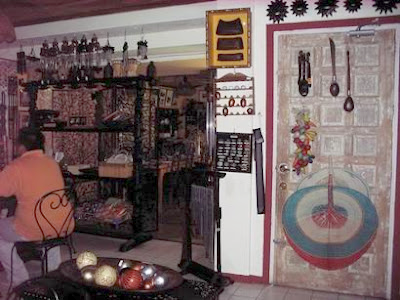
I’d give you the address and name of the restaurant, but I have a funny feeling the owners want the place a well-kept secret. In between my oooohs and aaaahs, upon entering the place (filled with old Filipino artifacts and antique furnishings), I grabbed my camera and started clicking. Before I could take my third shot, however, I was stopped by a lady. “I’m sorry, ma’am, pictures not allowed.”

“Should I erase the two shots I have just taken?” I asked, disappointed but obedient.

She replied with a smile perfected in customer service seminars, “Well, you don’t have to. But you can’t take any more.”

Okay, so I assume I have been given permission to post the two pictures of the place and one photo of the Durian Chocolate Cake (that one she allowed, as long as it is a close-up shot).


My  photo of the cake doesn’t nearly capture its indescribably delicious taste. So how come I feel like a heel for sharing this experience, but not really sharing it?

I feel like my cousin Benny when he was nine and I was six. He probably doesn’t remember it, but I do! He licked his two scoops of yellow and pink ice cream, perched on a brown, crispy cone, so very slowly—with big melodramatic sounds—while I sat drooling miserably, nursing an acute tonsillitis.

I also feel like I have an acute tonsillitis while dreading my next visit to my endocrinologist. I wish that my blood chemistry results will not reveal the Durian Chocolate Cake I succumbed to in Cebu, and will remain a sweet secret.

6/21/2007

Did I Forget Anything?


On the eve of my departure for Cebu City, where I have been invited for a series of book talks and book signing, I should by now be logging out. Although I think I am all packed and ready, there may still be one or two items which I missed.

Think . . . think . . .

Packing is a very tricky and baffling business. You count the number of days you’ll be away and match it with the same number of clothes and underwear, plus extras. Then on to toiletries, prescription and vitamin pills, and some cheap bling-blings. You tick off the items in your list, one at a time.

But somehow, when you get to where you’re headed, some of the small items which you thought you had are simply not there, even if you turned your luggage upside down.

It's predestined—I always forget some teensy weensy things which were in my “to-pack” list but, for reasons that escape me, never get thrown into the luggage. Nightie. Sunblock. Toothpaste (Why do most hotels withhold this item? It’s infinitely more important than the omnipresent hand and body lotion!) Shades. Vitamin pills. Reading glasses. Mobile phone. Battery charger. Camera. Battery charger. . .

Writing a post will clear my mind. After a paragraph or two, I should remember what my bag—still unzipped—is missing.

O, my plane ticket! Some cash and credit card!

That should be it. I will know for sure, alas, when I land in Cebu. And now to catch some sleep and shush my head from asking the question, “Did I forget anything?”

Before that, I pray for traveling mercies and draw upon the good Book an assurance, 2 Timothy 4:22 “The Lord be with your spirit. Grace be with you.”

6/16/2007

Special Three-hour Trip

Two of my favorite topics for “inspiration” exercises when I conduct a creative writing seminar are:

“The best thing I ever did for a child”
“The best thing an adult ever did for me as a child” 

I like them because I always get stories that move me to tears or tickle me to laughter, even from non-writers. Somehow, at one point in everyone’s life, an act of kindness—big or small—is etched in the heart.

It seems to be waiting for a chance to be retold. And when it is, it leaps at you, larger than life, as though it is happening for the first time. The emotions are fresh, and the images, crisp. Every word is caressed before it is finally released.

The beauty of these exercises is that they are not exclusive to seminar participants. Each time a story is retold, I remember my own two stories, and I am transported to certain special days and times when magic was real.

Let me tell you about “The best thing an adult ever did to me as a child.” As in research, this falls under the category, top-of-mind recall.

I must have been five or six years old when my father brought me to the nearest city from the small town where we lived. It was a three-hour bus ride. The purpose of the trip I can’t recall because it is irrelevant. But it must have been important for me to merit this rare, just-him-and-me, out-of-town treat.

On our trip home, the bus was packed. Aside from their bags, the passengers had with them big boxes, live chickens, sacks of rice, firewood, and many more. The conductor instructed all adults that the children they were with couldn’t have a seat except their laps. (Have you tried sitting on someone’s lap? It’s cozy for a while but it’s the most uncomfortable place to rest on, well, on a three-hour bus ride anyway.)

My dad crossed his legs and let me sit on the space where one of his legs would have been. From where I sat comfortably, by the window, I had the most spectacular view of many town plazas, rice fields, scarecrows, carabaos, birds, all kinds of people doing interesting things, and if I stretched my neck, I would see the mountains afar and the cloudless sky.

And my dad, he stayed in the same exact position--for three hours.

End of story.

Huh? That's it?!

I know it’s nothing earthshaking and may seem a little trivial. But why do I smile and feel warm whenever I remember that day? Why does it top my list as the best thing an adult ever did for me? Why is it that on Father's Day, it is the most vivid image I see when I think of the good times I had with my father?

Beats me.

What I know is that children are different from adults in ways we can never fathom. They treasure things adults ignore or may think insignificant.

In one of my book talks in Cebu City, a little girl about five years old came to me, touched my face so I could focus on her, and recited one of the pages of my book, “What’s for Breakfast?” from memory. I was so moved by her effort I hugged her.

“That’s the devotion for my birthday, May 5," she said.

“Oh, wow, you memorized it!” I said.

“You read it to me when you were here in Cebu one other time,” she said.

“I did?!” I honestly couldn’t remember.

“Yes, you asked me when my birthday was and you turned the book pages to my birthday and you read aloud the whole page!” she said, her eyes shining like 1,000-watt bulbs.

I . . . simply . . . couldn’t . . . remember.

I said a little prayer that when this little girl grows up, she will include my reading of her birthday devotion in her list of “The best thing an adult ever did for me.” It is now in mine as "The best thing I ever did for a child."

My father might not have thought much of that three-hour bus ride when I was five or six, but it stands alone as the best thing an adult ever did for me.

Enjoy the Lord's wondrous grace as you celebrate Father’s Day. 

6/10/2007

Choosing the Right Words

“When you stop learning, you stop living,” my late dad, a reading advocate, used to say. I took that to heart and try to learn something new everyday, hoping to live to a ripe old age.    
 

Yesterday I learned about the exciting world of anagram from my friend Adie. He and I share the same advocacy: advertising that adheres to the code of ethics. Which is why we see each other at least twice a month.

In our last meeting, while polishing off our lunch, we chatted about his favorite de-stressing activity: anagram. I gasped and rasped a “wow” at the lengths the world has gone to advance anagram art. Today it is a game that is becoming more and more popular among office executives throughout the English-speaking world.

Anagram as I knew it is was simply: a word or phrase spelled by rearranging the letters of another word or phrase—to discover a hidden meaning. Adie’s anagram of “Come to Marlboro Country” = “Cancer Tumor or Lobotomy” earned for him first prize in the worldwide anagram group to which he is an active member; and from me a standing ovation.

But, Adie tells me, that’s nothing. Anagram artists can now work on a poem, a whole essay, or even a book!

I had in mind images of Adie hunched for hours on his desk, ticking off each letter with a pencil and a huge eraser as he forms a new word from one word. “No,” he says. “I have just installed a software called Anagram Artist in my Mac.” This makes rearranging letters and words so much easier and faster. It also allows him, more than ever, to be more creative with the emerging new word or phrase.

Our conversation so fascinated me I surfed the net on anagrams. My mind-bending discoveries included Cory Calhoun’s anagram of Shakespeare’s (the Bard) most famous line in Hamlet:

“To be or not to be: that is the question, whether ‘tis nobler in the mind to suffer the slings and arrows of outrageous fortune.”

Anagram:

“In one of the Bard's best-thought-of tragedies, our insistent hero, Hamlet, queries on two fronts about how life turns rotten.”

Bravo!

I tried my hand at this new learning with the word “grace.” I came up with nothing. Grace is grace. It is complete.

I ponder the word, which is what this blog is all about in the first place, and its completeness—which is written in the scriptures—never fails to overwhelm. Paul, in 2 Corinthians 12:9 (ESV) quoted the Giver of unmerited gifts, "My grace is sufficient for you, for My power is made perfect in weakness."

As I ponder other words, put them together, and give them sense and dimension, I am bowled over by the gazillion of possibilities at my disposal.

Whether anagramming, writing, or simply wordsmithing, we all swim in endless possibilities. But in the end, one has to make choices from this sea of alternatives. It is in the picking that learning--and eventually, skill--takes shape. These come not from our own making, but from a power so big it makes ours so puny.

So, really, everything boils down to one word, grace.

Complete and sufficient, grace is at work when one gains insight into the right word choices that glorify the Giver.

Grace D. Chong = ragged conch? Ouch.

6/06/2007

What I Remember (Part 2)

I imagined Brunei (officially Negara Brunei Darussalam), a very rich country, to be as efficient as Singapore and as modern as Shanghai. I imagined glass and steel, cutting edge technology in a place teeming with all the trimmings money can buy.


My imagination failed me.

The Sultanate of Brunei is like a small, developing suburbia with a modest skyline and a landscape sparse in buildings. What it has is a dense water village with about 40,000 families living in homes connected to each other with wobbly wooden bridges. The first thought that comes to my mind is the sewerage system. 

The tour guide has a ready, and serious, answer, “Catfish. They’re in those waters and they eat anything and everything.”

On a motor boat, we tour the village, stopping to taste native food inside the biggest of them. As we totter over the rustic wood planks, I take a picture of my foot and beneath it I catch the yellowish water. Why people choose to live on water instead of dry land is beyond tourists like me.

The missing opulence in the landscape is concentrated on the mosque with 29 domes in 24-carat gold; the repository building of valuable gifts from foreign royalty and dignitaries; and the Sultan’s palace—the biggest in the world—with over 1,700 rooms!

Although not visible from the road because of the well-guarded fence and trees, I am able to take a shot of the huge 24-carat gold dome.

"We revere the royal family,” our tourist guide says and announces that alcoholic beverages are banned and therefore, “no nightlife.” It goes without saying that the country is very politically stable and that nobody from the less than 400,000 population will initiate any uprising.

Again, Filipinos are everywhere. One can always tell because they have that special, infectious smile that never lacks luster even under the direst of circumstances. They’re here—far away from their families—because they found jobs they can’t find at home.

My mind leaves Brunei and the cruise.
I remember that there are nine million Filipinos working in every part of the world—caregivers, housekeepers, nannies, waiters, chefs, seafarers, laborers, software designers, nurses, teachers, doctors, lawyers, etc.

These hardworking Pinoys brought to the Philippine coffers over 14 billion pesos in remittances last year, a much-needed boon to our gasping economy. The government calls them modern-day heroes.

They are. For they sacrifice much to be that—the familiarity of home, the culture they grew up in, their friends and families: mothers, fathers, siblings, wives, and children.

At the Captain’s Gala dinner that evening, between the appetizer and entrée, I chat with our assigned waiter, Richard, 28 years old, who looks spiffy in his tuxedo. He serves us well, extremely well, and his manners are impeccable. He hails from Tondo, Manila, and he has been on luxury ships for eight years as a waiter. Although unmarried, he supports his parents and younger siblings. “I work 12 hours a day, seven days a week,” he says nonchalantly.

“What?! No day off?!” I am horrified.

“Twelve hours is long enough for resting,” he says, meaning it. “Besides, where would I go on my day off? And after eight months, I get to sleep and rest all I want,” he adds.

Every member of the crew is hired for only eight months, after which he needs to renew his contract.

My friends and I quickly huddle into a caucus and unanimously decide to double the standard gratuity. It’s the least we can do for someone who deserves more than we do.

I remember other people at home who have at least one member of their family working abroad, serving people other than their own. I intend to tell them about Richard and all the other Pinoys I have met on board and in Sabah, Brunei, and Singapore—about how hard and efficiently they work, and how they make us proud.

And how God’s grace made it possible for me, on this cruise, to come face-to-face with living heroes.

"Travel is more than the seeing of sights; it is a change that goes on, deep and permanent, in the ideas of living." Miriam Beard

6/01/2007

What I Remember (Part 1)

“Like all great travelers, I have seen more than I remember, and remember more than I have seen," said Benjamin Disraeli. I quote him now because he describes me to a tee—in cruising and in living.

If my friends and fellow cruisers were to read what I am about to write, they'd most likely exclaim, “Were we on the same boat?!”

My family often says I either blow things up or shrink them down in writing—never in between. Well, I tell them, I am not a journalist. Having embraced creative writing, I remember only the statistics of my imagination.

Costa Allegra, our posh Italian dwelling at sea for a week, is pristine white, very large, and very proud. Dazzling at noon, it towers over Manila’s Pier 5, where my seven friends and I embark after showing the immigration officers our passport.

On board, people in all colors, speaking in varied European tongues, mill about comfortably, having been on it for days after their last stop in Hong Kong.

The opulence is a bit intimidating. It’s like being in limbo; one is unsure whether he is on earth or elsewhere. But after a while, one seems to fit right in, especially after hearing muted sounds in Filipino coming from the efficient crew in every nook and cranny.

Nena and I share a cabin—complete, compact and squeaky clean. I whine about no Cable TV, too small library, and choppy internet connection, outrageous at one Euro per two minutes! That’s P35 or US 0.80 per minute!

Nena reminds me of what this cruise is all about: 3F’s—food, fun, and fairy tale. I do a quick paradigm shift and promise myself to focus on what’s new, not on what I am used to.

It takes two nights, one day, two West-End-like evening presentations (bravissimo!), five meals from buffet tables laden with what could feed an archipelago, and hours of contemplating the wide blue yonder to get to Kota Kinabalu, the capital city of Sabah. This city with less than two million people seems to have magically sprung out of a forest. For indeed, Sabah on Borneo Island is encircled with forests.

“We have the cleanest air in the world,” our tour guide says proudly as he points to our next photo-op site, the tall one-pillar building of the Foundation Center.

For one fleeting moment, I rue about Sabah not being ours. This land is being leased from its rightful owner, a sultan of Sulu, Philippines! But in the 60’s, the inhabitants and the UN resolved to make it a state of Malaysia.

I remind myself . . . 3 F’s.

As we walk around the museums showcasing Sabah’s past, I see our own huts. Our cultures are interlocked; we share the same roots.

I follow my friends who earlier rushed to the curio shop. They gush at the novelty items. I look closely and they are the same as those I’ve seen in my frequent travels to Mindanao, Philippines. I skip shopping.

For me, the green, green horizon, endowed with more chlorophyll than all the trees I’ve ever seen, and the lush, lush flora (waiting to be explored), dotted with commercial areas and rimmed with well-paved, wide roads, are what make Kota Kinabalu a place worth visiting again.

Wherever we go, I hear the familiar lilt of my language from waiters, vendors, pedestrians, salesmen, doormen, and taxi drivers. I pause to smile and nod, and they smile and nod right back.

The Muslim mosques astound. Their over two dozen domes are made of 24-carat gold!

If melted, the precious metal would fetch a sum that could build two million modest huts for the homeless in my motherland.

At day’s end, in the taxi that takes us back to the port—where our floating palace stands regally illumined by the crescent moon—with my friends, their purchases crowding our feet and laps, I ask myself, “Having enjoyed a place cleaner, fresher, and prettier than my own, why do I miss home?”

5/28/2007

At Sea for a Week!

Dar she goes. . .

The brochure read, “Carrying only 800 passengers, the intimate Costa Allegra cruise ship is a vessel of imagination . . . art and artistry around every corner.”

Every bit of it is true, plus much more. I was on board this Italian ship with seven of my girl friends (plus two more, a son and a daughter, accompanying their moms) for almost a week.

I was figuratively and literally at sea. There was no internet connection and no cable TV. Most of the cruisers spoke either Spanish, Italian, French, or German. One had to spend in euro and a can of diet coke cost P350!

The library was small—or smaller than my own at home, with only one fourth of the books in English. But here I would spend my own quiet, special half hour, daily, while my friends attended mass in the chapel.

I took over a hundred photos (yes, this cruise taught me how to operate my digicam at record speed for those hurried snapshot land tours) and I have over a hundred anecdotes and reflections written in my head.

But at the moment, after flying from Singapore—last stop— in the wee hours of the morning, I neither have the energy nor the will to keep my eyes open even if I am back in my favorite corner at home with my computer and books which I missed terribly.

Yawwwwwn. I pray that the amazing grace which kept me wonderfully at sea for a week will keep me freshly alert on terra firma tomorrow.

Zzzzzzzzzzz.

(The two top photos are from the brochure. The bottom three [right, I missed the final show of American Idol!] are by moi, trying to capture the breathless moments.)

5/19/2007

A Mother's Day Like No Other

To say that my children are unusual is an understatement. They don’t try to be, they just are.

On Mother’s Day this year, I got no bouquet of fresh flowers or a Hallmark card with a touching note; no invitation to a fancy lunch or a dress-up dinner.

Two hours before lunch, I was told to remain as I was, in my work uniform—shorts, tees, flip-flops, and a stay-at-home face—by my two sons (JC and JR, first and third; second son JB is in Michigan, USA).

“Hop in the car, mom,” they said and drove me all the way to—you’ll never guess, Chinatown!

The deadliest heat was on in that busy part of Binondo district—you could fry potatoes, bake pies, or roast hot dogs on the dusty, narrow street leading to Sincerity, a small, crowded restaurant that seemed exactly the same as it was 60 years ago, only older, like a senior citizen looking his age. But it’s a Mecca of every foodie worth the name.

Third son had the menu all planned—fried chicken, oyster cake, and ngoyong (a spring roll look-alike but longer, meatier, and better). 

I wanted to order fried noodles and spinach as well but they said, nope, there’s more to come elsewhere. All three dishes were served on mismatched bowls, plates and saucers; there were no place mats, just undersized paper napkins; the spoons and forks, bent here and there, showed years of relentless use. 

But once my mouth took the first bite, all it wanted to do was relish and savor the taste till the last bit of morsel. No conversation could exist in this place. And burping was part of dessert.

Burp!
From there, I was hustled back to the steaming main road, Ongpin, and we padded to a building that’s a leftover from the Art Deco era. This restaurant that serves special Chinese fresh spring roll (minced carrot, celery, cabbage, pork, shrimp, onion; topped with crushed peanuts and garlic) has a ceiling two stories high, making one feel summer never comes. Two orders for the three of us, plus tall cold glasses of Chinese tea, capped that eating lap.

Three blocks and a dozen more burps later, I spotted the large faux emerald stone I’ve always wanted to complete my medium and small sizes at home, to match my collection of green bottles. I heard no grunt of impatience while I haggled and got the piece for P280.00 or $5.20.

We then walked through booths of the freshest fruits. Again, I stalled to haggle and buy a large grapefruit. They waited nearby, with none of the restless whining that completes their apparel when they accompany me shopping.

With my purchases safely ensconced in their hands, I was led up the stairs of an old wooden house with creaky floor. There, JC and JR order maki (sticky meat with brown sauce) for all three of us. By this time, my tummy told me, enough, but my mouth insisted, more! 

Finding our bowls empty, we filed out of Manosa, the name of the decrepit house cum eatery, and back to the long hair dryer masquerading as street.

We saw sugar cane bundled in the sidewalk and we dreamed of cold sugar cane juice. Lo and behold, right before our eyes was a sugar cane vendor. Glug, glug, glug. Aaahhhh.

Next pit stop, a store that sold dried meat or Chinese tapa for the husband (who defaulted in this trip because he doesn’t answer to the name mommy; and also because I am not his mother).

And yet another pit stop, the hopia (mongo/bean cake) rickety factory for its latest sugar-free offering, reserved for my marathon writing events in the coming days.

And one more, the chocolate (drink) factory for old-fashioned beverage treats at breakfast.

Then they hauled me to the gold jewelry section to indulge my fondness for glitters. But as I scanned the glimmering filigrees and chains, they had suddenly lost their luster (pun intended). For one brief shining moment, I realized these glitzy treasures had fallen to the lowest rung of my life’s priorities—a fact still unknown to them, and to me till that minute. But I couldn’t tell them, could I? It was a part of their itinerary.

Back to the stretch of an oven, we snaked through the increasing traffic, where the temperature was constant even at 3:30 PM. But by now, my skin was acclimatized, rewarded with a second wind in time for one, last pit stop—iced taro and black beans! 

Both concoctions washed down all the previous dishes neatly, like a period, at last, to a compound-complex sentence.

On our way back to the parking lot at 4:30 PM, my shirt was soaked and dripping with five-hour sweat, needing a quick change; my knees were buckling from the long walk, needing a massage.
And I never felt better! I felt dunked in grace, as though I had been gifted with a bouquet of fresh flowers, a Hallmark card with a touching note, and an invitation to a fancy lunch or a dressed-up dinner—all at one time.

My quiet song of thanksgiving was Lamentations 3:22 and 23: “The steadfast love of the Lord never ceases; His mercies never come to an end; they are new every morning; great is Your faithfulness.”

Right now I couldn’t find a single adjective that accurately describes that Mother’s Day. So let me steal a line from Randy Jackson of American Idol, after hearing an excellent performance from a contestant, “That was hot!”

Yeah, it was so unusually hot it was really cool. It was perfect.

(Photos in Chinatown: by JC, first son, taken with his mobile phone camera with almost zero mega-pixel. Photos of my emerald gems: by me as soon as we got home, with traces of my quivering, happy spirit still lingering and showing in the blur.)

5/14/2007

As for Me and My House


These past months in the Philippines, posters and streamers have covered building facades, walls, tree trunks, and fences; leaflets and sample ballots are strewn all over. On TV and radio, the political ads dominate the airwaves. The dailies brim with news of political campaigns, debates, and killings.

Finally, today, everything comes to a head. It is Election Day. An estimated 45 million voters will troop to the polls and choose their senators, governors, congressmen, mayors and other local officials.

A number of voters—wise ones—whom I personally know are NOT voting. In fact, only 10% of those who are abroad are going to participate in the “absentee voting” scheme in this election. They have their reasons:

“I have been voting every single time and what do we get? Officials who are in there for their own selfish reasons, never for the people.”

“Useless exercise! Nothing will ever change anyway. Once candidates taste power, they get sucked into the system of bad governance—corruption is ingrained in government.”


“Most of the candidates for senators are turncoats. They can’t be trusted. We are left with no choices.”


“We have been a developing country for so long. No election will ever make us into a developed one. The winners, most of them members of political dynasties, will drag us further down.”


“We have become one of the most corrupt countries in the world. In terms of progress, we’re trailing way behind countries which were once at the bottom.”


“It’s a sham! Cheating is in place. The powers-that-be will rig the elections the way they did the last time. Voting will just legitimize evil schemes."
These are big and strong arguments for one to be frustrated. And to lose hope! In the last five years, we have seen the greatest exodus of Filipinos—to find jobs and relocate their families in other lands.

But as for me and my house, we will vote.

Although we are just as frustrated, sometimes angry, as those who have given up on elections, we see this exercise as one chance—no matter how slim—to move forward and to bring about change. Out of the 37 candidates for senators, whose platforms we have discussed lengthily (with passion) among ourselves, we now have a list of 12. But each of our lists is different from the other.

Well, while we are a family, we are also individuals with differing, well substantiated opinions. But on one thing we agree: we will vote.

My son, JB and his wife Gianina, who are in the USA, have asked my husband for his list. I don’t know if they agree with that list, but they too, will vote.

I guess we believe in doing something to effect change. Up until we can come up with an alternative to elections, we will vote. I don’t begrudge those who refuse to vote, for this is democracy after all, but I feel that not voting is abdicating one’s duty as a citizen. I remember my late father, a lawyer, who used to remind me, “Voting is your right. Don’t squander it.”

It took America 200 years to get to where they are today—a world power. The Philippines is not even a hundred years old (I am counting from the time we were truly free from colonizers).

Is there hope? It may seem like there is none; like a prayer unanswered for so long. The Psalmist in Chapter 31 lamented, “How long O Lord? Will you forget me forever? How long will you hide your face from me?”

We’ve echoed this lament as a nation for so long, as well. We took to the streets and marched for what we believed in. In our Wednesday prayer meetings, our country and leaders always top our concerns.

Yet 70% of our countrymen are living below the poverty line (the government figures are different), squalor is everywhere, children are begging and sleeping in the streets.

For how long?

Will this election solve it? Will any election for that matter? For one thing, there are three righteous men in the list of candidates for senators. They belong to an independent party which has no machinery to wage a campaign, much less to win: Bautista, Paredes, and Sison. But I see them as symbols of change (one columnist calls them her conscience votes), and for as long as there are symbols, there is hope.

Like David, we lament and we get impatient seeing the Philippines as it is today, but we who believe in a God who is just and merciful know—there is hope indeed. Elections provide the teeniest of flickers, but it’s a sign of light nonetheless.

5/10/2007

Adrian

Years ago I lost a son. His name was Adrian.

Over time, the pain has dulled. But the what-might-have-been never really goes away. Not totally. Although my husband, Tony, and I never talk about that dark episode in our lives, Adrian's memory has a permanent place in each of our hearts.

It was a delicate pregnancy from the very beginning. With due care and complete medical attention, however, I completed my sixth month and was advised to stay in the hospital until I completed my seventh month. By then, Adrian would be ready for Cesarean section. Tony and I had a long list of names to choose from—one column for boys and one column for girls. In those days, the first question one asked after a delivery was, “Boy or girl?” The ultrasound was just an inspired thought.

But after only ten days in the hospital, my water broke. Adrian bounded out. Again, in those days, incubators or whatever you call those thingamajigs were not as equipped, as they are today, to save lives. Adrian’s lungs collapsed.

Tony and I shared a quiet, very quiet, grief. For there was nothing left to talk about. Close to seven months, we both talked all we could and tried to do everything so I might come into full term. But it was not to be.

My three living children are oblivious to this grief. JC was barely four years old when that happened. And JB was only conceived six months later. It took another five years before JR was born.

About the only connection they had with Adrian was our few-and-far-between visits to the Holy Cross Memorial Park where we would play a little game of searching for Adrian’s marble slab among the hundreds of similar slabs, sit under a tall tree nearby, and pan with our eyes the stretch of the cemetery. All this in a few minutes and we would leave again. Those trips were some kind of an informal ritual of remembering, nothing more.

Adrian’s name would also surface during our clan’s annual family reunion when we remember the clan members who have gone ahead. Again, this was another family ritual of remembering and an act of thanksgiving for their lives. Nothing more.

So, what next? How does this post end? It ends not of darkness that shadows loss; but with grace, it ends of brilliance that comes with gain.

A few days ago, Tony and I have been blessed with our very first grandson. JB’s wife, Gianina, gave birth to a healthy eight-pound baby boy! Born in a hospital in Grand Rapids, Michigan, USA, where JB is an internist, our grandson is beautiful. JB couldn’t quite describe him on the phone but I knew so—I am his grandmother. When his photos came in today, I have been proven right. For me, he has to be the best looking baby in the world!

His name is Adrian.

Of all the millions of existing or possible names, his parents chose Adrian for reasons only they know. It has never been verbalized, or maybe it was, but I didn’t hear. “Adrian lives on,” I think I heard Tony murmur, or was it just my imagination?

No matter.

Adrian, our son, and Adrian, our grandson—two separate beings, two separate blessings. One should not take the place of the other.

One’s life ended before it could start. And the other one’s life has just begun. But the fact that my grandson’s name is also Adrian makes my heart swell. I feel love flying from across the seas, welcomed home warmly; then on the return flight, we (I speak on Tony's behalf) send ours.

What’s in a name? Love cannot be dissected or analyzed. It is something that so wrenches and wrings your heart words need not be said.

Writing has taught me that people vary in how they express love. I find difficulty in expressing it sometimes—in words, anyway. Sometimes I don’t quite know how to receive it, or how to react to it.
Writing has taught me that humans fall short of love—in its giving or receiving. Only God, despite His power and authority over everyone, was willing to demonstrate love totally by dedicating His life and death on the cross to His sinful, mindless children, us, whom He loves.

Writing has taught me that we spend our lives looking for love and yet, when it is found, it couldn't be seized. Which is probably why I am writing, and continue to write till the Lord takes me home, because I can write about love better than I can show it.

I hope JB and Gianina read this post, because I don’t know how to thank them enough for naming their first son, Adrian. And for giving Tony and me a grandson we can dote on (wait till he comes to the Philippines!) and who will teach us how to love—with no reservation, inhibition, or condition. 

5/07/2007

Like a Fruitcake

My aunt, an American, warned me to never ask anyone his or her weight. "People will really take offense," she said. But her close friend, Elizabeth, whose body was twice wider than her height, never did. She had a great sense of self-deprecating humor and often laughed about her weight.

“Oh, Gracie,” she would coo, “you are sooo tiny. Me? Ooooh, I weigh five pounds less than a cow!”

That’s why when I am poised to take myself too seriously, I would think of Elizabeth and attempt to see her humor above it all. Laughing at oneself is liberating.

Yet there was one time I simply could not summon Elizabeth, even if I chanted, whistled and yodeled in my mind.

I had just launched my first “Gifts of Grace” book, which was attended by over 200 guests; many books were sold, and I signed them all. I was enjoying my new title: Author. It had a nice ring and nobility to it. To my mind, it ranked among the most respected careers in the world. 

When I attended my husband’s Rotary meeting, where the Anns (wives) were invited, I put a box of my books (24 in all) in the trunk of the car. It was two weeks before Christmas and I was sure my fellow Anns would be looking for great gifts for friends and family. The Anns occupied one table and the pleasantries were like a good game of ping-pong, exciting and unending.

Between one very short pause, I chimed in, “Hey, I just launched my first inspirational gift book. If you’re looking for gift items, this would be perfect. On cue, I took out a copy from my bag.

“How much?” one of them asked.

I was expecting questions like, “What’s it about?” “Oh, you’re an author?” Not, “How much?”??!!

"P195,” I replied.

“Hey, I am making fruitcakes for Christmas!” one other Ann said. “For you around this table, I am selling them at a very special price.”

“How much?” all of them asked, sight unseen.

“P220!”

“Hey, that’s very reasonable,” I heard a duet, a trio, a quartet, a choir.

“Yeah, put my order at five!” another added.

“Ten for me, please!” one other Ann said.

“Three!”

“Six!”

Elizabeth’s image suddenly became vaguely familiar, quickly fading from my range of vision. I dug into my bag for my cell phone and texted my husband who was in another table: "They like fruitcakes more than my book!"

His text reply: "Sharon Cuneta is more popular than Shakespeare." (Sharon is a famous actress/singer in our country.) Why, my husband knows his alliteration!  

Elizabeth’s huge image, her cow’s weight in 3-D and glowing colors, popped out of my cell phone. And I laughed.

I still think that “Author” has a nice ring and nobility to it. And I feel blessed that I have been given this role after a totally different career. It is precisely because I am an author that I get invited to many places to talk about creative writing—meeting new friends along the way.

Only a handful of the Anns are book lovers, a fact in our country that I must accept. 

Each time I am asked how I feel about being a book author, my heart sings: No other job has made me more aware that everything stands in relation to my Creator; it makes me acutely sensitive to the joyful moments of daily living; it’s a reflective life that gives me flashes of awe and wonder, through the old friends I have and the new friends I meet; now I am keenly aware that every little or big thing I can do is a gift of grace; and I am puzzled why it took me so long to take writing on . . .

But my voice pipe does an Elizabeth and says, “Feel? Like a fruitcake!”

5/03/2007

Surprise Oasis

Right smack in the busy area of Phom Penh was a surprise.

Just off the beaten tracks, some meters away from the main road, is a tall, nondescript fence that hid everything beyond it. Unlike the ornate gilded ones that were in abundance, and seemed to be in vogue, lining the major avenue from the airport, this colorless fence wouldn’t merit a second glance.

But as the gate opened, I gasped more audibly than I intended. This was what I saw.

And at that very minute I knew I had a home away from home. The two-storey house is all-wood, looking like the twin of the house I grew up in, except that this one is well kept and in tip-top condition, with a complete, vibrant family—American missionaries—living in it.

Since my parents went to glory, our family house has been decaying, and were it not for my sister who has decided to convert it into a public library, it would stand lonely and remain a relic of a happy, distant past. (Ooops, this is not about that crumbling house. It’s about the surprising oasis that pulsed with life in Cambodia.)

The chocolate brown house was surrounded with tall fruit trees, bushes, flowers of many different kinds and a walkway—all reminders of the province where I made my first steps and attended my first Sunday School. It also has a patio, roofed with nipa, tucked away at the rear which seemed to have been built for quiet times.


This private, unpretentious compound with its wide orchard and grounds (and a bedroom with walls that had luminous jumping sheep for counting, if sleep doesn't come), was my haven for seven nights and seven days.

Beats any five-star hotel anytime. After long, hot, energy-sapping hours of sharing all I know about creative writing to a group of fourteen, composed of mostly of locals and some expatriates, this was my home—replete with adorable children, ages 12 and 10 and their gracious parents; and a golden Labrador.


Here, my earlier fevered thoughts could take flight and come back stilled, as though God built this place for this purpose.

It wasn’t the “teaching” that melted my candle. I could teach all day and come out unscathed. It was the stories—the many, endless tales of pain from my “students.” Unbidden, these stories would creep in because they are integral parts of who they are.

So why do bad things happen to good people? I asked this oft repeated question again.

Ken Gire, in his book, “Seeing What is Sacred,” explains it so succinctly.

“This is the dark side of Christianity, the side we don’t see when we sign up. That if we want to be like Christ, we have to embrace both sides of his life.”

Gire’s examples of contrasts: the Christ who turned water into wine and the Christ who died on the cross. The clothed Christ and the one whose garment was stripped and gambled away. The Christ who fed the five thousand and the one who hungered for forty days in the wilderness. The free Christ, walking through wheat fields with his disciples, and the imprisoned Christ who was deserted by them.

At the end of the seminar/workshop, I was gifted with many stories that showed these two sides: the ache of suffering and the beauty of hope. And right in the patio on my last day, with the Labrador sitting on the floor by my side, the bouquet of roses they gave me distilled my thoughts—only a grace-filled life can enable one to understand and accept these permutations: thorns and beauty come together; or thorns bring out beauty; or beauty has thorns.

While we are on the subject of roses, and now that I am back at my home base in the Philippines, let me end with this text message I just received, “God did not promise a bed of roses. But He promised—'I will never leave you nor forsake you.'"

4/30/2007

Stories Waiting to be Told

This Cambodian Independence Monument stands proudly at the center of Phnom Penh. 
    
There is a park on one side (where I took the photo) and a shopping center on the other.

The serene park, with its lush plants, colorful flowers, and tall, shady trees, landscaped to perfection, seem to deny and defy the violence and brutality that once destroyed this small Asian country, and which are still too raw in our memory (at least in mine).

Here I stood in prayer that the re-emerging cultural, economic, social and political life of Cambodia—which was reduced to almost nothing and is undergoing reconstruction with the help of the UN, and economically, Europe, North America and Australia (and in our own small way, the Philippines)—will grow at a faster pace.

I did not cross over to the side which usually excites me. At that hot, humid hour, shopping seemed like a crime—or too insignificant to consider—in a place that is saddled with issues like illiteracy and poverty.

I had just made friends with a few Khmers whose life stories could melt even the coldest of hearts. I met—and got to know—them through the themes of their writings in an orphanage’s main hall where I conducted a Creative Writing for Children workshop.

Before I set foot on Phnom Penh, I was given a thorough briefing by the organization that invited me. I was to be given two translators to make it through 14 participants—ages 21 to 64. For their privacy, I will not mention names. Khmers are new at writing—at everything—since they are still rising from the ashes of devastation. I prepared a module (translated to Khmer way ahead of time) which was as basic as basic can be: from creation or ideation (as used in the ad industry) to wherever the four full days would take me.

I was prepared—for the worst.

What I was not prepared for was the excitement with which they embraced the idea of writing for children. And their speed in seizing concepts from each lesson. They were bursting with many, many stories waiting to be told. On our second day, they had created big ideas to leap from. And at the end of four days, they each had written a story, complete with conflict, action, and resolution.

I don’t know about their writing skills—for that comes with time, experience, and massive reading. But I know about their heart, which is what creative writing is all about. At the start of the first session, I talked about happiness and how a writer could translate his heart’s joy into powerful prose that touches young readers. Yet, as the day wore on, they wrote about sadness and ache and struggle that tore at their one captive reader: me.

How does one teach happiness? It can’t be taught—not even mandated; it can only be felt. And it will take some time before each of these new writers, some of them orphaned by parents slaughtered in the war, and all of them witnesses to other orphans who live in orphanages (the venue of our workshop included) run by missionaries, would know for sure.

But they know about hope. They believe, as I do, that beyond and beneath pain, there is Something far more important, and that happiness is forthcoming. These are 14 of the very small percentage of Christians in the whole country. Despite the sad tales of their themes, their endings speak of hope; of a Savior who understands because He did feel what they feel.

This is what makes them truly unique and remarkable. And what makes them astounding is the thought that—they are the core group of writers who will inspire young readers through books that brim with hope. It was, and is, our collective prayer that these books will usher in wounded children to a world of joy.

A part of the workshop was to read their drafts or tell their stories to the children in the orphanage. As I watched from the balcony, I could hear intermittent gasps and giggles. And I was, I am, certain that someday soon—when their works eventually get published—the underprivileged children who are their readers, would have more of the brief joy my own ears have heard.


(Last photo shows my foot on Cambodian ground.)

4/26/2007

Sizzling Hot


Phnom Penh, Cambodia is at its warmest this time of the year. And I am here. I have abandoned my early morning walk because I don't think I can last the hour. Every day is in the 40's at noon. Don't even try to imagine it, you'll sweat.

But the friendships I am blessed with are even warmer. I may not understand Kmer but I do understand the warm welcome extended to me at every turn. Cambodian food is yummyjust like Thai food, minus the sting.

I have tons of photos in my digicamI am slowly becoming good at fiddling with itbut I am using my host's computer (a Mac) and I don't quite know how to download them. There is no wi-fi connection so my laptop is sitting on my bed feeling useless. I hope to post a few of them when I get back home.

The creative writing workshop I am conducting is proceeding extremely well, way beyond my expectations. Creativity is cross-cultural and it is enriched by our differences.

I could write more but my sweat is getting in the way. I think this post has to stop here . . . at least for now.

4/24/2007

Graduation Blues

For the first time, since I started teaching part-time in a transnational business school four years ago, I missed the graduation ceremony.      
 

I am in Cambodia conducting a creative writing seminar/workshop.

Had I been there, I know I’d feel exactly the same way I did every year. Which is why I am posting the piece I wrote four years ago. Thanks to computers, it’s not rotting or misplaced in some drawer or box. It might have well been written today.

On Cloud Ten

With much interest, I watch the solemn graduation ceremony. Since it has nothing to do with any of my three sons, I am not focused on one face, but a sea of faces.

Edgy and expectant, the mothers (fathers have better muscle control) have their necks permanently cranked in the direction of their son or daughter. Their eyes, shiny and wide, blink rapidly. They are poised to watch their children walk to the last door of childhood, as they themselves struggle to contain overwhelming joy. The diploma is as much theirs as their children's. 

On cloud ninethat's the idiom that best describes this extreme elation. As a race and nation, we put a high premium on a college degree. 

"Education is all I could bequeath to you," is repeated in Filipino homes for generations. 

Even lacking in material wealth, parents work hard to send their children to college. A lot of walls are adorned with diplomas. Parents say with pride, "My children are all professionals."   
       
 
But to some us (okay, me), graduation is the great divide. Before that, our children must toe the line. After that, they can do what they want (read: get married or leave home). Done, finis

I have a problem with that. 

In fact, I have a personal metaphor for college graduation. It is a prism through which light passes, then separates into all colors, going in all directions. At least that was what I felt when each of my children graduated. Not on cloud nine, but a bit beyond that—on cloud ten? This feeling includes ardent pleas for grace from our Father—to unclutter my heart with the fear of "letting go"; to help these once tiny hunks continue to embrace the values I would have legislated if I could.  
  
There I am on cloud ten all over again. A good thing I am wearing a bulky toga with a hood that keeps sliding backwards, choking me. It was a welcome diversion, a perfect time to be reminded of God's admonition in Matthew 6:27, "Who of you by worrying can add a single hour to his life?"
 
The graduates, some of them my students, are wearing their best frocks underneath their black robes. Fresh from the beauty parlors of their moms, the girls are in Nine West heels. Wearing their dad's Armani neckties, the boys have abandoned their Nikes. Now clutching the rolled white paper that is their diploma, they display their retainers before the cameras while their perfumed mothers, clean-shaven fathers and bejeweled grandparents (with nurses in tow), grin beside them.

A very special day indeed.

Elsewhere, whether in very modest (or equally posh) surroundings, the same scenes are being reenacted. Having crossed the great divide, the graduates are high in spirits, teeming with smiles. Congratulations have never been uttered with more volume and exuberance.    

On cloud ten I feel all alone. I think none of the mothers in the hall has the same niggling dread about the future their children and they will have without each other.

Surely, they must know that the household landscape will henceforth change and will take some getting used to?

I spot the mother of the most outstanding student. "Your daughter will surely have a great future," my mouth moves on its own.

"You really think so?" she asks, her fearful eyes awaiting reassurance.

She is on cloud ten, I say silently, relieved that I am not alone.